Showing posts with label BMW. Show all posts

Saturday, June 25, 2011

2012 BMW M3 CRT Lightweight Sedan - Official Photos and Info

BMW builds a lightweight M3 GTS with four doors—and all of its color on the inside.
2012 BMW M3 CRT Lightweight Sedan
We first told you about BMW’s upcoming lightweight M3 sedan when it debuted as a concept car in April, following that up with a series of spy photos in May. Well, June is nearing its end, and we’d feel just horrible if we missed a monthly installment, so today we’re on to the thrilling conclusion in this three-part series. (At least until the surprise follow-up, when we drive the thing.)
In the lead-up to the Nürburgring 24 Hours race, BMW used its “M Night” celebration to debut the production version of this supersedan, officially called the BMW M3 CRT Lightweight Sedan, CRT standing for Carbon Racing Technologies. Unless you think every sports car needs a roll cage, which appeared on the M3 GTS coupe, the CRT won’t disappoint. (BMW has released video of the car; you can watch it here.)
Our earlier reports speculated that the sedan would make use of a standard M3’s 4.0-liter V-8, making a healthy 414 horsepower, but that won’t be the case. The CRT instead shares the GTS’s 4.4-liter, delivering 450 hp at a screaming 8300 rpm and 324 lb-ft of torque peaking at 3750 revs. Its crankcase is constructed out of an aluminum-silicon alloy, it has individual throttle butterflies, and its exhaust gasses exit through a sport exhaust system with a lightweight titanium muffler.
Carbon Fiber, Now With More Rigidity
This car isn’t called the M3 CRT Big Horsepower though, so let’s get to the things that make it lighter than a standard M3 sedan. Benefitting from new manufacturing processes developed for the carbon-intensive BMW i3 and i8 models coming in 2013, the M3 CRT has a hood that consists of two carbon-fiber sheets encasing an aramid composite honeycomb for added rigidity. As a result, it has the strength of a traditional steel hood with just a quarter of the weight. Compared to a normal M3’s aluminum piece, the weight is halved. Inside the cabin, the front bucket seats use the same process and therefore benefit from the same weight savings. The result is a car that weighs just 3483 pounds despite standard equipment that includes a dual-clutch transmission, navigation, a high-end BMW Individual audio system, and parking sensors. BMW says that, while the official weight savings is 100 pounds, if all this equipment is considered, the real savings is over 150 pounds. And considered alongside the car’s added horsepower, the cuts are good for a ratio of 7.7 pounds for each pony to carry, an improvement of roughly one full pound over the regular M3 sedan.
The M3 GTS carry-overs continue behind each of the car’s 19-inch lightweight wheels (wearing 245/35 rubber up front and 265/35 at the rear), with a set of more-rigid subframes and individually-adjustable dampers. The six-piston front brakes, also from the GTS, use calipers made of a special low-weight compound construction and, in the name of consistent pedal feel, stainless steel brake lines have been fitted.
Freeze Frame
Up until now, we’ve seen the car running around the Nürburgring in dark blue paint, but for its official debut, it now wears frozen (BMW’s word for matte) silver metallic paint with brick-red accents on the grille kidneys, spoilers, and side vents. Inside, the red theme continues, thankfully toned down by numerous swatches of black leather and aluminum trim, both in a carbon-fiber-weave pattern. Each car gets a numbered plaque and the most heavily bolstered rear seats we’ve seen since the old Mercedes-Benz 190E 2.3-16V. It almost looks as if the outboard seats were scooped out and red leather was glued in the holes.
You’ve probably been reading all of this knowing that there has to be some disappointing news somewhere. Here it is: The M3 CRT is limited to just 67 units, and not a single one will make it to the United States. According to BMW USA, items like those revolutionary front seats, which lack airbags, wouldn’t fly here. Because of the extremely low production volume, it’s simply easier to leave our market out of the mix than to give it special treatment. We’d try to be more upset, but let’s be honest: We all saw it coming.
Source : Caranddriver.com

Friday, June 17, 2011

2012 BMW M5 - Official Photos and Info

CARS REVIEWS - Meet the most powerful M5 ever

2012 BMW M5
Things are about to get a lot more normal under the hood of the BMW M5. The outgoing car packed an utterly insane 5.0-liter V-10, which made 500 hp—at a screaming 7750 rpm. Prior to that, the E39 M5, which was sold in the late 1990s and early 2000s, roared along with a 394-hp, 4.9-liter V-8. In terms of bringing ecstasy to drivers, that car didn’t so much compete with AMG-tuned Benzes as it did with freebasing. And now, BMW has given us the full scoop on the all-new, fifth-generation M5. Read on to find out just what the men from Munich have done to the 5er.
The First M5 to Come With a Turbocharger
The present and future of the automotive industry—even in the salacious world of high-performance über-sedans—sees big, naturally aspirated engines replaced by smaller mills, force-fed air through turbo- or supercharging. BMW’s M5 is no exception, banishing the wild V-10 from last generation to the history books, and installing a direct-injected, twin-turbocharged 4.4-liter V-8. BMW North America will advertise the powerplant at 560 hp. That would be four more than the Cadillac CTS-V’s supercharged V-8. The company promises 502 lb-ft of torque starting at a mere 1500 rpm, as well. These numbers may sound familiar if you’re a fan of the Bavarian propeller brand: the engine is already in service, making slightly less horsepower, in the X5 M and X6M.
Where the powertrain differs from that of the monster SUVs, however, is in delivering the goods to the pavement. The M-fettled X5 and X6 use a six-speed automatic and feature all-wheel drive, M’s latest 5-series will instead feature a seven-speed dual-clutch gearbox—a close relative of the transmission doing duty in the M3 and 335is—and while it hasn’t been announced yet, we expect a six-speed manual to be on offer to us Yankees. Regardless of the transmission, power is dispatched to the rear wheels only.
BMW projects that the M5 will be capable of a 0-to-62-mph run in 4.4 seconds, and a top speed of 190 mph for cars fitted with the M Driver’s package. (BMW hasn’t yet indicated whether this option will be available in the U.S.) Considering that we’ve seen times in the low-four-second range for the last-gen M5, we won’t be surprised if BMW’s acceleration estimate turns out to be conservative.
On to the Rest of the Car
The magic of the M brand may start with the engines, but we have high hopes for the rest of the M5 as well. The new sedan will feature BMW’s Active M differential—it’s essentially an electronic limited-slip—as well as the full M Drive feature set, allowing drivers to tap a button to make their M5 go from caged monster to outright fire-breather. Throttle response, damping, steering responsiveness, and the dual clutch’s shift program can all be altered with the flick of a switch, too.
Fortunately, BMW has installed hydraulic power steering for the new M5, not the electric power-steering system that's in use on most other 5-series models. We’ve been less than enthused with that system, so hope the retention of older-but-better hydraulic steering results in some actual steering feel in the M.
A New Suit—But Not Too New
Despite the often-raucous performance of cars festooned with the legendary M badge, most of the BMW M cars are tastefully upgraded with body kits and wheels. The effect isn’t as subtle as Audi’s S and RS treatments, but falls short of the baroque fittings on recent Mercedes-Benz AMG offerings. The new M5 should carry on this tradition, flaring its wheel arches, and adding the sub-brand’s characteristic chrome fender vents, a new lower rear fascia with a diffuser, quad exhaust outlets, and an integrated “Gurney-style” rear spoiler. The M5 will ride on standard 19-inch rims, with 20s available as an upgrade.
The interior of the M5 will be slathered with the high-end leather that you expect and your caboose demands. Sport seats bend and contour in every imaginable direction, there’s “aluminum trace” interior trim, and the car packs every gadget the Bavarian company offers: a head-up display, active and adaptive headlights, lane-departure warning, and enough cameras to satisfy the Department of Homeland Security.
BMW is planning to reveal the M5 to a live audience at the 24 Hours of the Nürburgring, and we’ll bring you any updates on the car’s specific tailoring for the U.S. market as soon as they’re available.
Source : Caranddriver.com

Monday, June 13, 2011

2011 BMW M3 "Frozen Black" Special Edition - Car News

BMW’s hot M3 may actually be best served Frozen—and in a limited edition of 20.

2011 BMW M3

How can something get hotter when it’s frozen? Easy: when it’s a “frozen” BMW M3. Like the 30 Frozen Gray Edition M3s that BMW offered last year, the Frozen Black Edition is a limited-run two-door, although just 20 will be served up this time around. Every Black will be equipped with the Competition package, BMW’s M-DCT dual-clutch transmission, and a black leather interior with red stitching. The paint is a matte-finish metallic black, accented by red brake calipers and gloss black wheels and body trim (grille inserts, window moldings, exhaust tips).

The Frozen Black Edition comes loaded with pretty much everything else on the M3 options list, including the Premium Package 2 (power-folding auto-dimming mirrors, universal garage-door opener, power front seats, carbon leather interior trim, interior mirror with compass, BMW Assist with Bluetooth), the Convenience package (alarm system, keyless entry, rear park-distance control, voice-activated navigation, iPod and USB inputs), heated front seats, satellite radio, and the BMW Individual Enhanced premium sound system. The package, BMW says, is intended to celebrate the arrival of a whole line of “Frozen” paint colors to the BMW Individual customization program.
Want one? Get on the horn to 1-800-245-4269 at exactly 11:30 a.m. Eastern on Thursday, June 16, and be prepared to shell out $81,825. If you’re one of the lucky 19 to get through—one example is being held back for possible sale at a later date; hello, auction!—by the end of the summer, you may have one of the coolest E90 M3s ever built.(UAC.com)
Source : http://www.caranddriver.com/

Thursday, June 9, 2011

BMW “Don’t Txt & Drive” Ad Campaign

UAC.com - BMW is launching their “Don’t Txt & Drive” national advertising campaign of tv, print, online and radio messages designed to raise awareness and show the consequences of distracted driving. The campaign theme of “Don’t Txt & Drive – When the Engine Starts the Texting Stops” will illustrate different situations of careless parents endangering their children with distracted driving and will run from June throughout the year.
The U.S. Transportation Secretary Ray LaHood states that, “Distracted driving is an epidemic in America, and it has deadly consequences for thousands of people on our roads each year”. The U.S. Department of Transportation also provides shocking statistics that nearly 5500 people died in car accidents in 2009  involving distracted drivers, while the National Highway Traffic Safety Administration found http://popsop.com/wp-content/uploads/bmw_logo.jpg iPod Adapter Charge and Audio Cable with USB and 3.5mm for Select BMW and Mini Cooper Car Models - Control From Your Wheel
that nearly 87 percent of teens admit they text while driving. All of this has prompted BMW to become involved in this campagin of urging drivers to put down their phones and focus on the road. Jim O’Donnell, CEO of BMW of North America states, “We developed this campaign to be impactful in hopes of evoking emotion and conveying the serious dangers of distracted driving and its potential consequences.” In efforts to reach out to teens, the “Don’t Txt & Drive” message will also be incorporated in more than 100 teen driving schools across the United States.
The first television ad from BMW’s “Don’t Txt & Drive” campaign shows the contradiction of being an overprotective parent and the carelessness of texting while driving with the fatal effects of picking up a cell phone.  
Source : http://reviews.carreview.com/

Monday, January 31, 2011

New BMW S 1000 RR Wallpaper

New BMW S 1000 RR Wallpaper


Saturday, January 1, 2011

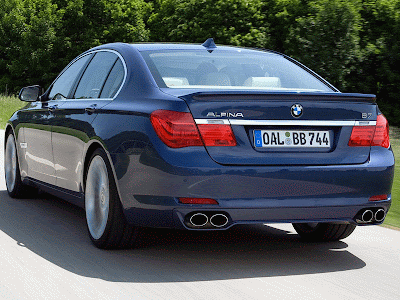
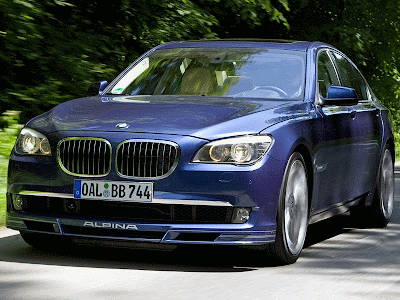
ALPINA B7 BMW luxury Sport Sedan

Both short- and long-wheelbase models will be offered. The BMW ALPINA B7 will make its North American premiere at the 2010 Chicago Auto Show in February, and go on sale at authorized BMW Centers in Spring of 2010. Bmw announced today the prices for the 2011 Alpina B7 for US - $122,875 (standard wheelbase) and $126,775 (extended wheelbase). BMW of North America announced that the BMW ALPINA B7 sedan will join BMW’s North American product range as the most dynamic 7 Series model. The BMW ALPINA B7 represents the second generation of ALPINA automobiles based on the BMW 7 Series to be offered in the US. The first BMW ALPINA B7 was offered as a limited edition for the 2007 and 2008 model years. Newly interpreted and based on the current BMW 7 Series platform, the B7 will again set the benchmark in terms of performance, refinement, technology, luxury and exclusivity. However, Alpina B7 is slightly less powerful that the 760i, but it looks very very sporty and aggressive.
ALPINA B7 BMW luxury Sport Sedan

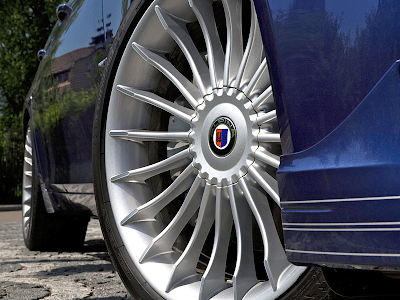
Yielding exquisite levels of power and torque from the twin-turbocharged 4.4 liter V8, and in conjunction with the electronically-adjustable suspension with active roll stabilization, the new B7 promises to offer a spectrum of driving experiences so broad as to be unheard of in this class of automobiles. The evolution of the traditional 20-spoke 21” ALPINA CLASSIC wheels underline the fresh design language found throughout the B7 and impart it a distinctive appearance and powerful stance.
ALPINA – a name famous in Europe and the wider world for putting a particular performance accent on BMWs, though not yet so well-known in North America. BMW – a name famous all over the world for motor vehicles of performance, quality, luxury and safety.
The two companies, both at home in the German state of Bavaria, have a long history of working together to produce special BMW automobiles. Burkard Bovensiepen, son of the founder of ALPINA Business Machines and an enthusastic racing driver/engineer, began his automotive career path in 1961 by developing a dual-carburetor setup for the just-introduced BMW 1500 sedan. It was a predictive beginning: to take an already fine-performing BMW (which also just happened to be a practical sedan) and making it perform even better.
ALPINA B7 BMW luxury Sport Sedan

By 1964, BMW had officially recognized ALPINA’s contribution to BMW performance. Not long thereafter, Burkard Bovensiepen founded the ALPINA company – ALPINA Burkard Bovensiepen KG – that continues today, creating special versions of BMW automobiles that offer a particular brand of performance for discriminating auto enthusiasts. Yet outside the circle of dedicated BMW enthusiasts, ALPINA has kept a low profile in North America. In addition to racing versions of BMWs, ALPINA has developed a progression of BMW-based cars based on 3, 5, 6, 8, Z4 and Z8 models and offered them on a limited-production basis. ALPINA is located in the small Bavarian city of Buchloe, some 50 miles southwest of Munich, BMW’s headquarters city and the capital of Bavaria.
ALPINA B7 BMW luxury Sport Sedan

The B7 is the newest manifestation of the unique BMW-ALPINA synergy – once again based on the BMW 7 Series luxury sedan. Currently, BMW offers ultra-performance models of its 3, 5, 6, X5 and X6 Series developed by BMW M, BMW’s own performance subsidiary. For an ultra-performance version of the 7 Series – a vehicle defined by luxury and generous interior space – something other than “M” performance character was called for. In recent models, ALPINA has concentrated on delivering very high levels of performance with moderate rpm ranges and automatic transmission. Most appropriately, the new BMW ALPINA B7 applies this philosophy to the newest 7 Series to produce a luxury sedan of stunning performance. “A 7 Series Beyond,” one might say.

Wednesday, December 22, 2010

Nex-Gen BMW Sports Sedan 3 Series Coupe And Convertible

A little after a leaked brochure gave us our first taste of the lightly refreshed 2011 3-Series Coupe and Convertible models, BMW rushed out an official release and a whole bunch of pictures. For the 2011 model year, the Bavarian automaker's bread-and-butter coupe and cabriolet models receive some minor cosmetic touches and updated powerplants.
2011 BMW 3-Series Coupe and Convertible
The most notable - that is, if you're a hardcore bimmer fan- changes on the outside concern the widened kidney grille, reshaped LED headlamps, front and rear bumpers with restyled lower fascias, new exterior mirrors and finally, reworked tail light cluster with a new color scheme.
2011 BMW 3-Series Coupe and Convertible
The only change in the cabin concerns the convertible models and the use of sun-reflective technology to mitigate temperatures on leather seating, armrest surfaces, headrests, and gear shifter. BMW says that this new treatment is able to reduce surface temperatures on dark interior colors by up to 20 Celsius degrees (36 Fahrenheit degrees) and by as much as Celsius degrees (27 Fahrenheit degrees)on light-colored upholstery.
2011 BMW 3-Series Coupe and Convertible
The next-generation BMW 3 Series isn't that far off, with the sports sedan expected to debut sometime in 2011 as a 2012 model. Yet the Munich brand isn't sitting on its hands in the meantime – the current 3 Series coupe and convertible are getting a mild refresh and updated powerplants this spring for the 2011 model year. The most immediately noticeable change are headlamp clusters that get a subtle reshaping to go along with a wider grille and reworked lower front fascia. At the rear, the taillamps retain the same shape, but the reflectors are redesigned with some of the light-pipe styling found in other recent Bimmers.
2011 BMW 3-Series Coupe and Convertible
The 3 Series coupe will now be offered with xDrive all-wheel drive, while the 3 Series convertible gets a new solar reflective leather upholstery that BMW claims helps keep seat temperatures down when the lid is open.
2011 BMW 3-Series Coupe and Convertible
The most significant updates come underhood, where the much lauded twin-turbocharged 3.0-liter inline-six is being replaced by a new single turbo version. The revised engine, dubbed N55, has recently been launched in the 740i and the 535i Gran Turismo. The twin scroll turbo has dual exhaust inlets that allow the engineers to better balance the pulses coming in to spin up the turbine faster. This is expected to reduce the turbo lag that some drivers complained about with the outgoing twin turbo setup.
2011 BMW 3-Series Coupe and Convertible
BMW also claims it has reduced cold-start emissions by routing all the exhaust gases through a single, larger catalytic converter that heats up faster. On the intake side, the throttle is eliminated thanks to the addition of BMW's Valvetronic variable valve control system. The N55 also gets direct fuel injection. The end result is the same 300 horsepower and 300 pound-feet of torque as before, but with a fatter torque curve that maintains its peak from 1,200-5,000 rpm.
2011 BMW 3-Series Coupe and Convertible
The new design of the taillights is unique to the 3 Series Coupe and Convertible. The rear light cluster feature two-piece L-shapes and are further accentuated by a new color scheme. With two rows of light tubes that illuminate simultaneously, they create a night design with depth and dimension. Integrated flush into the body of the car, the lights are split into two sections and extend up the trunk lid, blending with the character lines from the side profile. These styling tweaks have resulted in a slightly longer length and larger overhangs (29mm (1.14 inches) at the front, and 3mm (0.12 inches) at the rear)
2011 BMW 3-Series Coupe and Convertible
Though the updated BMW 3 Series Coupe and Convertible will go on sale this Spring, pricing and fuel economy figures haven't been announced as of yet. The former is expected to fall in the range of the current car's pricing, which starts at $37,075 for the 328i Coupe, $42,535 for the 335i Coupe, $45,875 for the 328i Convertible and $52,075 for the 335i Convertible. The latter is expected to be a small improvement in fuel economy for the new single-turbo engine over the current twin-turbo engine's 17 mpg city and 26 mpg highway.

motorsport modification | motorcycle news update | new motor bikes |BMW Tries Subliminal Advertising Experiment for the BMW S 1000 RR

With the occasion of promoting the BMW S1000 RR sport bike, the manufacturer decided to try something different than the usual commercial, especially considering how technology has evolved. For this reason, the Serviceplan company was chosen to add some subliminal advertising to the clip. See bellow the explanation and full ad.
BMW S 1000 RR
BMW S 1000 RR

The Munich-based company used what’s known as an after-image to print the BMW logo on the eyes of the audience that attended the experiment but the logo wasn’t visible on the screen and couldn’t be seen until Ruben Xaus, the star of the clip, gave the magic command “Close your eyes”. When the members of the audience closed their eyes, the logo instantly appeared to everyone’s amazement.
A lot of positive feedback was provided at the end of the screening and this may be an interesting way of promoting something without actually showing any logos. It will be interesting to see if BMW will integrate this in further screenings.
See bellow the same ad, but bear in mind the fact that it was screened in a cinema so you may not experience the same effect as those who whitnessed it firsthand.

Wednesday, December 15, 2010

2011 New BMW X3: Martha Stewart Designs


Post by: Automotive


Martha Stewart has accepted an invitation from BMW to design your dream BMW X3 Sports Activity Vehicle BMW using "E 'Dream. Building. Driving." Programme. Martha used the "Build Your Own" tool online at bmwusa.com to customize your BMW X3.

Customization is a specialty for the new BMW X3, the vehicle has more than 70 million unique configurations. Martha Stewart has designed her to have a X3xDrive35i Sparkling Bronze Metallic exterior, one of three special exterior colors that are available only for the BMW X3 custom orders. Martha's BMW X3 has a Sand Beige Nevada leather upholstery and wood interior trim Fineline Wave.


Recently, Martha and The Martha Stewart Show "crew went to Spartanburg, South Carolina to watch the production of its BMW X3. Martha experienced firsthand where BMW makes all the BMW X3, X5 and X6 vehicles to customers around the world and has interviewed people who make them. The last stop of the day was the BMW Performance Center, where Martha tested the last car on the track driving his BMW.

Viewers can watch Martha's visit to BMW on Tuesday, December 14 at 10:00 ET / 9 c on "The Martha Stewart Show" on Hallmark Channel. During the show, Martha will have the keys of his very own BMW and visitors will be encouraged to continue watching the show to find out how to enter for a chance to win your BMW X3.
source: BMW Press

2011 BMW 1-series M Coupe

Post by: Automotive

With the anticipation of fans around the world at its peak, the BMW M GmbH introduced the newest member of its product family intimate. For the first time, M coveted badge has been given to the popular 1-Series BMW 1-Series in the form of all-new BMW M Coupe. Badge M submitted after two years of the development process through the BMW M engineers and test drivers achieve extraordinary power delivery and a signature, near-perfect driving behavior of the BMW M cars. 2011 BMW 1-Series M Coupe will be available in limited quantities and with limited options on the Official BMW Center in Spring, 2011.

"Eigenwillig," the German word for "self-willed," "individual," and "decided to go their own way," has been the right word to describe the M car is unique and impressive than the last three decades. With the original 1988 BMW M3 as his inspiration, 2011 BMW 1-Series M Coupe combines the raw ability of a racing car with the agility, flexibility, and a seated position from a compact sedan to the BMW Ultimate Driving Machine ® makes pure. Thus, the BMW 1-Series M Coupe continues the tradition of BMW M. eigenwillig With the latest two-door model, BMW M is to describe the ability to build a performance car racing into a small car, capable of daily use.


Dimensions and Construction

New BMW 1-Series M Coupe has been developed for near-perfect balance and footprint, a large square. It is 71 inches (1803mm) wide - 4.8 inches (122mm) wider than its 1988 ancestor M3 - but only 1.3 inches (33mm) longer at 172.4 inches (4379mm) long. New BMW 1-Series M Coupe weighs in at 1495 kg DIN (£ 3296, the beginning), and features a wheelbase (2659mm) 104.7 inches, three inches longer than the M3 of 1988. Front and rear track width is exactly the same on the BMW 1-Series M Coupe at 60.7 inches (1542mm) each. Compared with 2011 BMW 135i Coupe, BMW 1-Series M Coupe is 0.2 inches (5 mm) longer, 2.1 inches (53mm) wider, 0.5 inches (13mm) taller, and rides on a 104.7-inch same (2659mm) wheelbase. Features a track 2.8 inches (71mm) wider in front and 1.8 inches (46mm) wider in the rear, and DIN weight 35kg (77 lbs, preliminary) less.

New BMW 1-Series M Coupe features a high strength steel unibody, with a unique, widened fenders and rear quarter panel to house track widened substantially. He also has a metal roof panel that saves about 35 lbs (15kg) compared to the BMW 1-Series models are equipped with a moonroof. 2011 BMW 1-Series M Coupe, built as one of the most BMW vehicles performance-oriented in recent years, may not be offered with a moonroof. This weight savings - at the highest point of vehicle - provide an appropriate reduction in the center of gravity, which contributes to enhanced driving dynamics. It also helps maximize head room (or space helmets, such as might occur).

Engineering chassis is "faster than the engine"

Providing sure-foot responsive handling for high performance, powerful and luxurious coupe, while keeping mass under control, presented many challenges for the engineers of BMW M. The result is an aluminum suspension which was originally for the current generation M3, and tuned specifically for this model in the BMW M Nurburgring Nordschleife test center. Of course, every BMW design begins with preparing the main components in a way that allows near-perfect front / rear weight balance (51.7/48.3).

Almost all aluminum front-end components, including front struts, swivel bearings, central subframe and an additional impetus panel below the engine serving to maximize lateral stiffness of the entire front.

At the rear axle, subframe, transverse arms, arm track, and wheel hubs have been reviewed by M to the ideal kinematics, geometry and stiffness. Virtually every detail on the five-arm rear axle made of aluminum and a new generation of BMW M cars, including aluminum dampers.

Both front and rear axles feature hollow bar anti-roll optimized for function and body weight. Combining two additional longitudinal reinforcement bars, axle kinematics tailored to the perfect way to track a whole and the character of the car. As a result, both in terms of stability and weight, according to the balanced performance concept of every BMW M vehicles.

Compounds Brakes and Wheels

A powerful braking system suitable for a car with performance that far was originally developed for the current generation BMW M3. The players internally-vented, cross-drilled iron discs measure 14.2 inches (360mm) diameter in front and 13.8 inches (350mm) at rear. Featuring large compound disc brakes and electronic anti-lock, stopping power for the BMW 1-Series M Coupe a strong, precise and consistent. Each disk is connected to a floating aluminum hub by cast-in stainless steel pin. This configuration reduces the thermal load on the disk, thus improving their performance and service life. An electrically-driven pump provides the vacuum system.

Service - and safety - is enhanced thanks to an integrated wear indicator which, through a dash display, allows the driver to monitor the condition of brake. Brake Service - closed for four years or 50,000 miles under the BMW Ultimate Service - thus can be given when necessary without guesswork.

BMW 1-Series M Coupe is equipped with a wheel, M light-alloy-specific cross-talk from the M3 Competition Package and GTS limited-production M3. They measure 19 x 9 inches with low-profile tires 245/35/R19 on the front and 19 x 10 inches with tires 265/35/R19 in the back, and silver in color.

In the BMW 1-Series M Coupe, the transmission power to the rear wheel also provides an ideal base for exciting driving dynamics because of segregation of duties consistent drivetrain and steering. Steering rack-and-pinion equipped with hydraulic power steering system called Servotronic, which regulates impulse in relation to road speed.

Engine

Heart of every BMW is the engine, and an inline-6 with exceptional performance, behavioral free-revving, and pushing and shoving endless BMW 1-Series M Coupe. This concept is known: in the history of BMW M models, high-revving inline-6 is one of the classic machine formats. In the second and third generation of the BMW M3, the-inline 6 became famous because it combines high output, sharp response, and a loud voice. In the BMW 1-Series M Coupe, the inline-6 engine concept embodied in the most up-to-date form.

twin-turbocharged, all-aluminum, 3.0-liter inline-6 engine is characterized by instantaneous response to accelerator pedal, sounds fantastic, and free-revving spirit. The combination of low-mass turbochargers and twin BMW High Precision Injection direct offer naturally-aspirated engine output will only be able to provide through movement of more cylinders and bigger.

The system was developed for the engine turbocharger 1-Series BMW M Coupe maintain high output throughout the engine speed range. Maximum output of 335 hp (250 kW) delivered at 5900 rpm. nominal peak torque is 332 pounds-ft (450 Nm) from 1,500 rpm to 4500 rpm. Redline is 7000 rpm. An enhanced engine management system BMW 1-Series M Coupe includes electronic overboost function which briefly controlled increase torque at full load conditions by another 37-lb ft (50 Nm). This peak torque of 369 temporary lb-ft to give the car a substantial increase in acceleration. BMW 1-Series M Coupe will complete the sprint from stop to 60 mph in just 4.7 seconds (0-100 km / h in 4.9 seconds). Signs emerged standing quarter mile in 13.2 seconds. Top speed is limited electronically to 155 mph (250 km / h).

Signature sound to accompany the wave power

Exhaust system from the BMW 1-Series M Coupe is set by M specifically for this new model. acoustic technique gives the car a unique personality in all phases of operation. M exhaust system easily recognized by the presence of four signing of the exhaust pipe.

Drive M Button

New BMW 1-Series M Coupe is also equipped with steering wheel-mounted M button Drive which makes its first appearance in 2006 M5. In the BMW 1-Series M Coupe, M button to activate the program sharp throttle response for the sportiest driving. This means that the engine performance characteristics can vary according to the driver's wishes.

6-speed Manual Transmission

A ratio 6-speed manual transmission is used for transmission power close to the rear wheels on the BMW 1-Series M Coupe. It is specifically designed to interact with high torque engines and have been suitable for this purpose with flood cooling system dry. A flywheel upgrade to high-torque applications installed between the engine and transmission. This transmission is operated using a lever M is very short gearshift. final drive ratio of 3.15:1.

Variable M differential lock, DSC with M Dynamic Mode

BMW 1-Series M Coupe is equipped with variable M differential lock. This produces the locking torque on-demand and variable, thus providing optimal rear-wheel drive traction on all road surfaces. The key response variable M differential rotation velocity difference on the right and left rear wheel, direct drive torque in a split second. So where there are significant differences in the coefficient of friction between the right and left rear wheels, for example, optimum traction and propulsion possible maximum is guaranteed. Centrifuge principle of variable M differential lock to support the dynamic nature of both rear wheels on slippery surfaces and when accelerating out of bends.

This gives the BMW 1-Series Coupe M benefits traction on slippery surfaces, snow and sand. It also supports auto-sporty style in the narrow, winding roads like a mountain pass since the optimum traction and a maximum torque available drive when accelerating out of corners. So in this model, the variable M differential lock proves ideal support for the dynamic nature of rear-wheel drive.

Dynamic Stability Control (DSC) from the BMW 1-Series M Coupe includes elements such as Antilock Brake System (ABS), a function of anti-slip control (ASC), brake assistant Dynamic Brake Control (DBC), hill-hold assistant to start off, Cornering Brake Control (CBC), the function of brake fade compensation and Brake drying function. In wet or slippery surfaces DSC secretly intervened to limit oversteer.

As an alternative to the status of normal operation, the driver can activate the M Dynamic Mode (MDM) MDM by pressing the button between the front air vents, increasing the threshold of intervention of the DSC system. MDM allows very little oversteer dynamic in specific situations to enable the vehicle yaw optimized for maximum performance. Demonstrations at the BMW Performance Center in Spartanburg, SC has been shown to activate the MDM mode lick the fastest-possible performance while still providing assurance and protection of the Dynamic Stability Control. MDM also facilitate the start of the snow or loose surface carefully controlled amount of wheelspin. DSC can be entirely disabled via a press-button long MDM (ABS remain active.)

Innovative Aerodynamics: Water Curtain

Consistency of form and function is very important for engineers at BMW M, the search for the perfect balance of various factors aerodynamics in wind tunnels. As a result, the BMW 1-Series M Coupe is equipped with the latest innovations BMW aerodynamics. air curtains, used here for the first time in a production vehicle BMW, enhance airflow around the wheel arches with the benefits of turbulence are significantly reduced.

Innovative aerodynamic features consist of openings on the outside bottom of the front fascia that routes high-pressure air through channels in every corner of the front. Channel approximately 10 x 3 cm wide and is designed to channel air to the openings in front of each wheel arch, where he disposed of through a very narrow hole at high speed. Air flow out covers the side of the front wheel like a curtain, thus reducing aerodynamic turbulence that is not profitable in the vicinity of rotating wheels.

This feature has a key role in the development of aerodynamic innovation future. An example of the principle of the air curtain was first presented in the BMW Vision EfficientDynamics concept study at the International Motor Show (IAA) in Frankfurt in 2009, and the developer BMW 1-Series M Coupe takes the task of pioneering application of this element for the production vehicle. To do so, they utilize the unique capabilities of the new full scale "rolling road" wind tunnel testing at the BMW Group Aerolab Aerodynamic Center.

Design

There are three exterior paint finish to choose from for the BMW 1-Series M Coupe. In addition to non-metallic Alpine White and Black Sapphire Metallic, Valencia Orange Metallic available exclusively for high-performance compact sports car.

Strongly shaped front fascia is dominated by three large air intake that is safe for air cooling of high-performance engines. Air enters the central area is covered by a honeycomb grille-structured, while the two outer intake that actually open. This means that in every situation on the road or track, a number large enough cooling air is fed directly into the engine oil cooler on the right and to the additional cooling radiator on the left.

With greenhouse convey the impression of light, strong shoulder line of distinctive and complex sculpted surfaces symbolize athleticism precisely controlled in the profile. The wheel arches of the model 2-door bulge out especially voluminously both in front and rear. One of the characteristic features of M is a chrome gill elements in the front wheel arches are very elongated. It bears the turn indicator M brand and logos, as well as forming the starting point of the character line along the door handles to the rear. A vertical edge of the contour starts at the element that leads to a threshold gill side. Fine-tuning in the wind tunnel has also formed a design of the exterior mirror. In their basic form are the same as those of the BMW M3.

Strong wheel arches that also makes the back of the BMW 1-Series M Coupe seems to be very broad. The horizontal line is set emphasizes this impression. A wise spoiler lip on the trunk lid to produce additional downforce on the rear axle at high speeds. Rear fascia has a side opening that echoes the appearance of Water Curtain intake in the front fascia. M symmetry visual characteristics that are created by two sets of chrome twin tailpipes, each positioned towards the outer edge. L-shaped rear light clusters with red glass cover makes nighttime lighting characteristics. In this, the backlight is provided by two banks of lights fed by the LED units.

BMW 1-Series M Coupe features standard Adaptive Xenon headlights. Twin round lights cut at the top of the LED-fed "eyebrows." This is what creates the appearance focused BMW 1-Series M Coupe.

Interior Focus

M-special cockpit developed exclusively for BMW 1-Series M Coupe is designed to facilitate focus, sporty driving. High-quality, black Alcantara with orange contrast stitching covers the door panels, door pull, binnacle instrument cluster, dashboard panels and gearshift lever boot and hand brake. Driver's attention is focused on the M-specific instrument cluster with a fast gray, classic red M pointers, and a white backlight. A driver's footrest and frame M M round entry of a unique interior.

Black leather sports seats in the Boston standard has orange contrast stitching and logo on the front of M arise each headrest. heating Seats are available for both front seats. The orange contrast stitching is also echoed in the back seat and in all the design elements featuring Alcantara. M leather multifunction steering wheel now features M-everywhere Keys to spontaneous activation of sharp throttle response and M Dynamic Mode DSC.

The dominance of dark surfaces, including the A pillar and the anthracite headliner trim to reduce the glare of the sun and promote a focus on the road. In combination with high-quality materials, contour plan, and selective color accents, the interior of the BMW 1-Series M Coupe providing the perfect environment for the pursuit of driving pleasure.

Safety Equipment

BMW vigorously pursue a philosophy of safety with three key modes: a avoid accidents), superior, b) superior crash survivability, and notices c) comprehensive post-accident. BMW 1-Series M Coupe features a wide selection of standard equipment that underlines BMW's safety culture research. Standard safety features include front, pelvis-thorax and side head curtain airbags, automatic three-point seatbelts for all seats with pretensioners and belt force limiting belt in front. Models equipped with BMW Assist BMW Enhanced Automatic Collision Notification, which alerts authorities when an airbag deployment has occurred. Furthermore, data from on-board safety systems are processed and analyzed through algorithms so that the vehicle ownership URGENCY BMW Assist can provide call centers with a special notice when the occupants tend to experience severe injuries.

source: BMW Press

Wednesday, December 8, 2010

Saturday, December 4, 2010

motor sports |motoGP |motorcycle modification news update | 2010 BMW S1000RR First Ride

Whether you love or hate the design of the S1000RR once you ride one  it will no longer matter.
Know for the high-performance capabilities of its autos, has BMW finally found the ultimate driving machine on two-wheels with its S1000RR literbike?
De Uber Speed King

‘The Ultimate Driving Machine.’ BMW has touted such a statement to describe its four-wheeled vehicles for decades. And for good reason. The German firm’s line of cars, from family sedans to M performance machines, has always been on the cutting edge of performance and drivability. Could the same be said for their motorcycles, though? In a true sporting sense, No. While they have dominated areas like adventure riding with its GS line and long-distance touring with the LT range, a purebred sportbike has always eluded the Bavarian brand, something that has perplexed us for years. Until now. Enter the 2010 BMW S1000RR.

And as such, no amount of terrible airline food or long layovers could stop us from riding the highly touted new machine, which is why this story is coming to you straight from a hotel room in Portugal, mere hours after riding the new propeller-branded bombshell.

So, without further ado…

Engine

Let’s start at the heart of the beast, the essence of what BMW has always been known for. And while it may not be a strange Boxer motor, the somewhat traditional Inline-Four was designed and built 100% in-house in BMW’s Berlin facility. In fact, the entire motorcycle is built in its German super facility.

The S 1000 RR comes with the most advanced and sophisticated digital motor electronics currently available on a motorcycle. The software incorporated in this sophisticated BMS-KP  short for BMW Engine Management with Anti-Knock Control  is an in-house development by BMW Motorrad specifi cally for motorcycle applications.
BMW took the Inline-Four approach for its Superbike project, but features more oversquare configuration at 80 x 49.7mm.
Titanium valves  both intake and exhaust  are actuated by equally small and light single cam followers. Valve play is compensated by means of adjustment platelets running on the spring plates.
The 33.5mm intake and 27.3mm exhaust valves are made from lightweight titanium and feature a narrow valve angle. The valve springs are supplemented by a hydraulic tightening mechanism to eliminate valve flotation.
Though don’t fret all you BMW lovers, as well as connoisseurs of speed in general. It may be similar in basic design to the Japanese competition, but it takes things to a whole new level. Instantly noticeable from the first lap exiting the pits, seat-of-the-pants says this bad boy has the Japanese covered by a healthy margin.

These prancing ponies come via 999cc lump. Sporting a an extremely oversquare 80 x 49.7mm bore and stroke, this equates to a very short stoke ratio of 0.621 and the biggest bore of any 1K sportbike on the market. A forged, single-piece and heat-treated steel crankshaft is mated to “anti-friction” bearings and features traditional 180-degree angles for a consistent firing order. Con-rods are also steel, but are said to be an “extra-light” forged makeup, weighting 334 grams each. At the end of each of these sit forged lightweight “box” pistons with a thin-ring design for less dynamic friction. Each piston weights a mere 253 grams as well, further reducing internal rotational mass.

This is all housed in a horizontally split aluminum crankcase, the upper section die-cast to form a stiff overall unit. This upper half also holds a very small 6-speed stacked gearbox which mates to a wet slipper clutch. Above sits a cylinder block featuring nikasil coating for reduced friction and wear, while a compact cylinder head features a narrow valve angle (11.2 degree intake and 13.3 degree exhaust), claimed to “provide ideal intake ducts as well as a compact combustion chamber for high compression.”

Both intake and exhaust valves are lightweight titanium and measure a rather large 33.5mm intake and 27.3mm exhaust. These are operated by valve springs as well as a hydraulic tightening mechanism to reduce drag forces and allow power to be produced at high rpms without the chance of valve flotation. Small and light individual cam followers are also utilized to allow BMW the freedom to optimize valve lift and duration. This all equates to an astronomic – in liter-bike street terms – redline of 14,200 rpm, of which BMW says the engine could be run much higher in pure mechanical terms – i.e. if long-term street durability wasn’t a factor.

Cylinders bank forward at a 32-degree angle, which was obtainable due to the extremely small overall size of the engine. Despite the large 80mm bore the powerplant only measures 18.23 inches wide at the crankshaft. Height is also a vertically challenged 22 inches top to bottom, allowing low and “optimum” placement within the chassis. Another byproduct of this size is a featherweight 131.8-lb engine weight, said to be the lightest of the any stock 1000cc sportbike currently produced.

With a compression ratio of 13:1  it pops the front tire up with ease.
Producing a claimed 193 horsepower at the crank, the S1000RR clocked top speeds during our first ride in excess of 180mph in Portugal.
Spent gases exit through a 4-2-1 stainless exhaust system that features a main section under the engine, in which equal length of piping from each cylinder is routed, then exiting through a small and low, right hand muffler. This centralizes mass beneath the engine to further aid in moving the CG as low as possible.

With a compression ration of 13:1, the final result is a lump that produces a claimed whopping 193 hp at the crank, which BMW say translates to roughly 180 hp at the wheel. While this may be a tad optimistic (we’re guessing in the 170 hp range), compared to the best we’ve seen of low 160s from the Japanese and it’s easy to see the difference.
And while the following may sound like a bit of regurgitated PR, one run down the front straight at Portimao and it all quickly became quite believable. From as low as 3000rpm right up to the 14K redline she pulls like a factory Superbike dressed in drag.

As it happens, I personally just returned from riding all seven factory World Superbikes at the some Portimao circuit less than three weeks ago, making for a perfect comparison. To give to an example of the new BMW’s engine performance, my top speed on Ben Spies’ factory Yamaha R1 was 301 km/h (187 mph) at the end of the massive front straight, and according to the data on the stock S1000RR I clocked high 280s with ease and a peak of 289 km/h (180 mph), a mere 12 Km/h (7 mph) down on the world championship-winning machine. To say this is impressive is an understatement. These speeds on the stock Beemer were also equally as quick as the factory-supported Kawasaki WSBK I rode at the same time. Unreal!

But power without control is nothing. And making the S1000RR even better is the smooth progression in which the heaps of hp are delivered. Fuel delivery is spot-on from as low as 1000 rpm and at no point are there any hiccups or spikes of any kind.

The ABS was the only item that took some getting used to on the S1000RR  but with the option to turn it off  handling and braking was spot on.
Full-lean provides a good view of the S1000RR exhaust system, which exits out a shorty right-side exhaust canister and keeps the center of gravity as low as possible.
This is the result of BMW’s engine management system, called BMS-KP (BMW Engine Management with Anti-Knock Control), which controls fuel and ignition mapping for each cylinder independently. Variable intake control, which changes the intake length based on rpm and throttle position plays a roll, as does their E-Gas ride-by-wire throttle system that continually adjusts the butterflies of the 48mm throttle bodies.

It is further aided, in part, by the DTC (Dynamic Traction Control) system. Our test units came fully kitted with the DTC and integrated ABS system, a first for a production sportbike. Four modes: Rain, Sport, Race and Slick are available for the rider to choose from, with Slick needing a special plug under the seat to be installed to access. This plug comes with the bike if you buy the optional upgrade.

The Rain setting limits power output to 150 hp at the crank and turns the traction control up to a very high level so as to allow for easier riding on slick surfaces like in the wet or for less experienced riders. We tried this for the first couple laps getting used to the track on new tires and while it was nice on new tires, once the buns were heated I was quickly into Sport and then Race mode, as Rain cuts in quite a lot and prevents any steering of the motorcycle with the rear tire.

Full power is gained in Sport, Race and Slick modes, but the delivery is changed as the modes increase, giving the rider faster throttle response as you progress up the ladder. All of the systems work in conjunction with the integrated electronic ABS as well as a wheelie control function. Though Slick mode does away with the wheelie control, only leaving the DTC and ABS in place. Simply holding down a button on the left switch cluster can also turn off the entire system.

The S1000RR may weight in at a claimed 455 lbs. wet  but with a low center of gravity  it doesnt feel like it.
Gripping the Portimao circuit was Metzeler Racetec K3, with the S1000RR's DTC (Dynamic Traction Control) system offering four optional settings.
And while Slick mode may have been designed for slick tires, the Metzeler Racetec K3 rubber on the machines were plenty grippy to allow such setting to be used and also what I found to be optimal. Much of this revolved around the wheelie control function, as on the track it wasn’t quite able to keep up, making for abrupt deceleration and some slightly violent rides cresting Portimao’s hills. At a flatter track or on the street, if one didn’t want to wheelie, I think the system could do fine, but with the drastic elevation changes of the Portuguese track this wasn’t the case. Not to mention, I’m quite the fan of wheelies in general, so to limit them on such a machine is the ultimate tease.

Our machines also came with the option HP Gearshift Assistant, or in non-Germanic terms, a speed-shifter. This allowed for full-throttle up-shifts without the use of the clutch, and the system worked flawlessly in all conditions. The back-torque-limiting clutch worked equally well, though in its case under braking, as long as one was sure to fully engage the clutch lever for each downshift. If not, false neutrals could be found, but only if the rider was ham-fisted with the hand controls.
With the DTC system in the Sport mode  full power of the S1000RR is avaiable to the rider.
Mondo power is great, but needs to be teamed with world-class handling. The Beemer delivers both in spades.

Chassis

Harnessing the harrowing horsepower is BMW’s aluminum bridge frame, which uses the engine as a stressed member and weighs in at 26.42 lbs. The frame is comprised of four castings, designed to allow flex to be tuned differently along each axis. It also serves to make the machine as slim as possible between the rider’s legs for optimum ergonomics.

The steering head and the two side sections with their integrated engine mounts are made from ‘tip casting’ aluminum. The rear section, swingarm supports as well as the mounting points for the footrests are produced from a low-pressure die-casting process. A “high-precision welding robot” then assembles the individual pieces in the “Aluminum Competence Centre” at BMW’s Motorrad Berlin plant. The subframe is a welded structure comprised of square aluminum pieces that are bolted to the frame and as such is removable.

Due to the compactness of the engine BMW was able to utilize a long swingarm, to provide as much mechanical grip as possible. Measuring 23.35 inches from the rotation point to the center of the rear axle, this is one of the longest on the market today. It is made up of deep-drawn and very thin aluminum plates on top welded to a cast-dish base. This makes for a stiff unit that also only weights 13.72 lbs. An eccentric housing at the frame joint allows for swingarm adjustability, something only seen on a few high-end sportbikes.

As an option the S 1000 RR is available with a very light slip-on muffler made of titanium and with a carbon trim cover at the rear. The supplier of this special muffler in its very sporting and dynamic design is Akrapovic.
The S1000RR sports one of the longest swingarms on the market and is also adjustable at the engine pivot, as is the wheelbase.
Suspension is handled via a massive 46mm front fork; featuring very German-like 10 clicks of rebound and compression adjustability, as well as spring preload. The steering head is also adjustable up to 15mm, allowing the front end to be lowered up to 5mm or raised 10mm as compared to stock. Same can be found out back, with a single shock featuring compression, rebound and spring preload tune-ability. Rear ride height can be changed up to 10mm using eccentric inserts in the upper shock support.

Reducing rotational mass are “very light and extra stiff” aluminum wheels. Designed with Supersport racing in mind, the thin 10-spoke wheels are pressure cast aluminum. Furthermore, the front brake rotors bolt directly to floating mounts on the wheel, eliminating carriers and an extra set of bolts found on most common wheel and brake setups. These 17-inch wheels come shod with 120/17 and 190/55 size tires front and back, respectively. Three different brands will be used; we rode on Metzeler K3 rubber in Portugal.

Slowing things down are dual front Brembo four-piston radial calipers that grab 320mm rotors via steel-braided brake lines and a radial master cylinder, while out back a single-piston Brembo caliper grabs a 220mm disc. The model we rode also featured BMW Motorrad Race ABS, which adjusts depending on the aforementioned setting (Rain, Sport, Race, Slick) in which the bike is used. The system only weights 5.51 lbs, making it the lightest on any production sportbike.

The thin 10-spoke aluminum wheels help shave weight. Paired with Brembo four-piston calipers and the S1000RR stops on a dime.
Developed by top-shelf riders, like Jurgen Fuchs, the BMW's chassis handles the rigorous requirements of track use with ease.
While the engine is without question the eye-opening and shining point of the new Beemer, the chassis and suspension isn’t far behind. Developed by BMWs fast and well-trained testing staff, which includes former world-class racers like Jurgen Fuchs, the base setup was well balanced and stout, giving great feedback to the rider.

The compactness of the chassis allows for a machine that feels very small between one’s legs and combined with the shape of the tank makes for an ergonomics packages that fits nearly all size riders. My small stature had no problem flicking it from side to side, while none of the taller riders complained of it being cramped.

Although the overall weight is on the high side at a claimed 455 lbs full of fuel, due to the low CG and centralized mass one barely feels it, allowing for quick and easy transitions in both the slow and fast sections of the track. Equally capable was the feel and feedback once leaned on its side. Each and every bump was translated directly to the rider, as if one was strapped straight to the pavement.

Initially the shock was a bit soft and would transfer weight to the rear somewhat excessively under hard acceleration, but a few clicks of compression to keep it up in the stroke and she was good to go. Otherwise I left it exactly as setup by BMW and it worked as well as anyone could ever hope from a production machine on stock tires.

And speaking of the stock tires, Metzler’s K3 impressed greatly. Similar to the Pirelli Diablo SP3, these have to be one of the best OE tires on the track I personally have even ridden. Only complaint, if you want to call it that, is they get greasy after about 20-25 minutes of straight hard riding. But for a street-based tire that’s hardly a complaint and more like a compliment.

Up front  the S1000RR allows riders to raise or lower the front end to customize the handling.
The new S1000RR makes power and handles like a proper Superbike. No more scratching Boxer engine heads in the corners! Bring on the big shootout...
The only other minor complaint was the ABS system under hard braking. In the lower settings it would initiate quite early in a predictive manner, and while it doesn’t pulse or do anything funny, it does give back a mushy feeling through the front fork and lacks some feedback at the brake lever. This was slightly better in the higher settings, but even in Slick mode one could feel it under extreme conditions. However, with the system totally off full brake feel and feedback comes back.

Design

It’s impossible not to have an opinion about the styling of the new BMW. Everyone does. Why is this? Because for the first time on a sportbike the faring design and lighting is quite asymmetrical, with two completely different side panels as well as totally different headlights.

The different fairings are almost easy to miss, as they are never viewed together at any one time, so this rarely a point of contention. The headlights, on the other hand, are. Sitting right next to each other and very different in shape, I must say at first I wasn’t a fan. And while I’m still not totally sold, they are growing on me.

Why did they do this, you might ask? First off, performance. The high-beam projector didn’t need to be as big as the low beam, thus by making it smaller they saved weight. But the big thing was to be different. With an engine configuration the same as the Japanese, BMW needed something to call their own, something to separate them from the pack. And no doubt the angular lines, crazy shaped taillight and asymmetric bodywork have accomplished exactly that. Equally different is the green color they chose for us to ride, which they say is very “urban” focused.

The bodywork is also very much wind tunnel influenced to provide optimum aerodynamics while still giving the machine a small “600cc Supersport feel,” according to the Germans.

The S1000RRs unique headlight assymetry is sure to rile some.
The asymmetrical headlight configuration of the S1000RR is bound to rile some, but where will the Beemer fall when the 2010 Superbike Smackdown finishes?
Sitting behind the controversial shrouding is a very techno gauge cluster that features an analog tach and digital speedo, as well a host of racetrack-focused digital readouts. A built-in lap timer can be accessed via the high beam switch on the left bar, as well though a censor that works with any 2D transponder. Also available to the rider is his max speed as well as percentage of overall brake pressure and throttle opening for each recorded lap.

Final Verdict

Without shooting myself in the foot before we get the BMW back to the U.S. for a proper shootout, I can tell you this bike impressed more than any production motorcycle in recent memory. Utterly amazing power harnessed by a communicative chassis and very adjustable suspension, plus high-tech electronics, make for a bike that should no doubt push the envelope of liter-class machines worldwide. And all this for a base price of $13,800.

All hail the 2010 Superbike Smackdown. It gets better by the minute…

Sunday, November 28, 2010

2010 BMW F800R Chris Pfeiffer Europe Edition


2010 BMW F800R Chris Pfeiffer Europe Edition

Chris Pfeiffer was at the Berlin Spandau plant in person at the beginning of July 2009 for the start of serial production of this F 800 R special model: he lent a hand himself and even rode the very first BMW F 800 R Chris Pfeiffer off the assembly line. As a small thank-you for this first special model bearing his name, the four-times World and European Stunt-Riding Champion provided a “best of” selection from his numerous stunt shows and competitions for the staff at the BMW Motorrad production plant. As he said when it was all over: “I am very pleased and proud that there will be a BMW Motorcycle on sale which bears my name. I regard this as both a great honour and powerful source of motivation. Riding the first machine to bear my signature off the production line really was a unique experience.”

2011 BMW Motorrad Motorsport New Model

2011 BMW Motorrad Motorsport Front View 2011 BMW Motorrad Motorsport New Model 
2011 BMW Motorrad Motorsport Front View
Baviera assignment is continuing on the alertness of the 2011 division for the FIM World Superbike. Course work, the two pilots who will booty allotment in abutting year’s World Series of daughter, the accomplished Australian Troy Corser, and the new purchase, the Englishman Leon Haslam, from the Aggregation Alstare Suzuki. The brace spent the day bygone in the wind adit at the aerodynamics administration of the BMW Group in Monaco of Bavaria (GER). The capital intention, as can be imagined, was to optimize the aerodynamic position of both riders on the BMW S 1000 RR. The analysis took abode in a apish acceleration of up to 240 km / h, area the two riders accept approved altered anatomy positions in the saddle, in adjustment to acquisition the everyman accessible attrition and convalescent the Cx.
2011 BMW Motorrad Motorsport Side View 2011 BMW Motorrad Motorsport New Model 
2011 BMW Motorrad Motorsport Side View
The aggregation additionally formed on optimizing the ability of the aerodynamic allowance of the BMW S 1000 RR in adaptation 2011. All abstracts calm will now be analyzed in detail by the technicians of Monaco of Bavaria, appropriate on the base of these results, the bike will be accessible and able for the abutting winter analysis to be captivated in backward November at Jerez.
“The driving position is the main factor for the overall aerodynamic efficiency of the rider-bike package – said Rainer Baumel, Technical Director, Team BMW Motorrad Motorsport – The locations of the head and upper body, elbows, knees and feet, can have enormous influence on the resistance, and thus on lap times. Of course, there is a location that is ideal for all drivers, because everything depends on any factors and several singles, starting with the same height and stature. The intensive work in the wind tunnel with Troy and Leon led the pilots themselves to discover their best position. At the same time, we are trying to improve the aerodynamic efficiency of the bike as much as possible within the strict technical standards. – continues Baumel – This is why we evaluated various shapes and positions of the fairing. We collected a lot of important data that will help us with the bike set-up for next test. “
Troy Leon and of advance are continuing with their concrete alertness for the accessible season. As you apprehend this, are demography allotment in the affected “training fettle BMW , area they will be accomplished by the added riders of the SBK Team BMW Motorrad Italy: James Toseland (GBR), Ayrton Badovini (ITA) and all the added drivers accommodating in the Championship Enduro .

Wednesday, November 17, 2010

BMW S1000RR in Playboy

Since 1964 Playboy gives every girl a car, awarded the annual title “Playmate of the Year”. This year, the most beautiful girl in the opinion of Playboy has been a Hope Dworaczyk, but the gift she chose not to auto and motorcycle. The BMW timely warning in advance, and 25-year-old beauty has been blessed with a new sportbike S1000RR, with whom she was caught in the glossy pages of the magazine.
Incidentally, the first time in 45 years instead of the car the girl was given to a motorcycle. BMW rejoice the advent of photography in the revered men’s magazines, and the model went on to study law and to spend $ 100 000, which got on top of a motorcycle.


Sunday, November 7, 2010

2011 BMW K1300S Photo Gallery

2011 BMW K1300S Pictures2011 BMW K1300S Pictures

2011 BMW K1300S White Series2011 BMW K1300S White Series

2011 BMW K1300S Sportbike2011 BMW K1300S Sportbike

2011 BMW K1300S Red2011 BMW K1300S Red

2011 BMW K1300S Blue Color2011 BMW K1300S Blue Color

Twitter Delicious Facebook Digg Stumbleupon Favorites More

 
Design by Free WordPress Themes | Bloggerized by Lasantha - Premium Blogger Themes | Affiliate Network Reviews