Showing posts with label Cars design. Show all posts

Monday, June 27, 2011

New Cars - Hyundai Elantra

http://www.autobytel.com/images/2007/Hyundai/Elantra/400/07_Hyundai_Elantra_28.jpg 
Hyundai Reviews -  One of the likely consequences of the federal government's push for more stringent fuel economy standards is that more people will be driving smaller cars in the future. Not too long ago, with the exception of a few distinguished compact cars, that didn't look like a very appealing reality.
That's changed with the debut of efficient models like the Chevrolet Cruze, the upcoming 2012 Ford Focus and now the redesigned Hyundai Elantra. The Elantra has all the makings of a sales success: stop-and-stare styling, a fuel-sipping four-cylinder engine and an optimal blend of ride comfort and handling poise — all at a competitive price.
In short, the Elantra is a home run in the compact segment, allowing more drivers to happily enter a fuel-efficient future.
The 2011 Elantra sedan is available at Hyundai dealerships now and is offered in two trim levels: base GLS and upscale Limited. I tested automatic-transmission versions of both trims; click here for a side-by-side comparison of the two models.
Styling
The redesigned Elantra makes a good case for being the most stylish new compact sedan on the market. The car's designer, Cedric D'Andre, said one of the goals of the design was to create a car that was at least as sporty-looking as the Honda Civic, which still has a modern look even though it hasn't been fully redesigned since the 2006 model year. Hyundai has definitely met its goal, as the Elantra's styling is as dynamic as it gets in this class.
http://images.thetruthaboutcars.com/2009/08/2009_hyundai_elantra-touring-5.jpg
Like the Civic, the Elantra's front roof pillars have been stretched toward the front fenders, resulting in a windshield with greater rake. This gives the car a streamlined appearance, but the left pillar blocks your view a little when navigating winding roads. The car has the look of a coupe as the rear window stretches nearly to the tail, resulting in a short trunklid.
Besides the appealing proportions, there's also a bit of visual flair almost everywhere you look. Pronounced hood and door creases, arching fender flares and a trunklid lip spoiler all contribute to a level of sophistication that's been mostly absent in compact-car designs, until recently. I'd been wondering what car was going to challenge the new Focus from a styling standpoint, and with the new Elantra that question has been answered — and then some.
Efficiency & Drivability
https://blogger.googleusercontent.com/img/b/R29vZ2xl/AVvXsEi4pIMg3fqIy-uipi7yFuK_22am1W7X1QXQ2UzPGNM34uKzqYpX3e6jK_x0m5GYni3iwbE4zzLOdfo2wWCU_K2ZlvZztI5yL9AxLH5yYGGzIKWvhvysyoLOLSlEbCvsPEUhuFJGMHyo1aA/s1600/hyundai+elantra+hacthback+2004+niot.net.jpgAutomakers have been racing to produce small cars that get great gas mileage using conventional engines, and Hyundai has succeeded on that front with the 2011 Elantra, which is powered by a new 148-horsepower, 1.8-liter four-cylinder that gets an EPA-estimated 29/40 mpg city/highway with either the manual or automatic transmission. And Hyundai didn't sacrifice drivability to achieve those thrifty mileage figures.
There's no denying the Elantra is a modestly powered car, but so are most of its competitors, including the Civic, Cruze and Toyota Corolla. There are times when you need to use a heavy foot to pick up the pace — like when merging on the highway — but the Elantra gets around well at city speeds and on rural roads. Even when revved high, the engine sounds refined, with no buzzing from the engine bay.
As gas mileage promises to be a big selling point for the Elantra, I wanted to get a sense of its real-world efficiency. In one leg of driving that totaled slightly more than 100 miles, my driving partner and I averaged 38 mpg, according to the Elantra's trip computer. The route consisted of mostly traffic-free rural roads and urban freeways, with some city driving mixed in. The terrain was hilly, the air conditioning was running and neither of us altered our driving style to get better mileage. We were, in fact, hustling the car pretty aggressively.
Contributing to the Elantra's thrifty fuel use and good drivability is its optional six-speed automatic, which is a new Hyundai-developed transmission. The automatic's shifts are refined — even under hard acceleration — and quick. The transmission also doesn't race to get to its highest gear — a fuel-saving tactic some cars use — which improves responsiveness. The automatic listens attentively to your right foot; jab the gas pedal when cruising, and it readily kicks down a gear. The transmission's clutchless-manual mode is also quick to respond to driver-initiated gear changes, with none of the delay that plagues many of these systems and makes them unrewarding to use.
Ride & Handling
Before driving the Elantra, I had my reservations about its driving dynamics. Some of Hyundai's other small models, like the Tucson crossover, don't offer the best driving experience, and I wondered if Hyundai had figured things out with this car. After spending a day driving it in and around San Diego, it's clear the automaker has. The Elantra's combination of ride comfort and handling should please both everyday commuters and those who like to tackle a winding road now and then.
I consider myself in the latter category, and Hyundai's drive route — which took us close enough to Mexico that we could see the border fence just a few hundred yards from the road — provided miles of serpentine asphalt.
One of the most interesting aspects of the Elantra is how willingly it tackles curving roads. The car resists body roll, even when pushed hard into a corner, and lifting on the gas slightly had the effect of helping bring the tail through the corner more quickly, enhancing the car's already nimble feeling. The Elantra's suspension tuning makes it a sporty choice in the style of the Mazda3, which ranks as one of the more engaging mainstream compact cars available in the U.S.
I also got a feel for the car in more mundane driving, like highway cruising. Here, ride quality isn't as sensitive to rough pavement as it is in a Civic nor as isolating as in a Corolla, but it skews more toward the Civic. The ride is taut, but not overly so. Suspension rebound over dips and bumps is controlled, and there's a solidity to the design that's been missing in some other Hyundais, which have noisy suspensions. It's also quiet enough in the cabin at highway speeds to hold a conversation without having to raise your voice.
The Elantra has electric power steering, and it doesn't take much effort to turn the wheel. The car has very good straight-line tracking. The only time the steering seems to get a little flustered is in sections of continuous switchbacks where you need to turn the wheel back and forth again and again; there, the wheel feels numb.
A Cabin That Matches the Exterior's Promise
The Elantra's exterior sets high design expectations, but the cabin gets a fair dose of style itself. It's stylish in numerous ways, from the simple yet elegant ventilation system knobs to the slender control panel in the middle of the dashboard. The cabin is unequivocally modern — but not at the expense of occupant comfort.
For a small car, the front of the Elantra's cabin feels spacious, easily accommodating my 6-foot-1 frame. The standard height-adjustable driver's seat is a nice feature, and the seat went far enough back for me to sit comfortably. However, the steering wheel's optional telescoping feature doesn't extend far enough for taller people.
Besides giving the cabin a unique look, the slender center panel opens up more room for your knees than many conventional designs offer. You don't feel cramped in this car, and headroom is still pretty good in models with a moonroof — a feature that tends to rob space.
There was a time when roughly finished cabins were more common in this class, but refined interiors are becoming the norm, and the Elantra's compares well with the best of them. It features mostly high-grade materials — some of which have interesting patterns — and good fit and finish. Hyundai even went so far as to give the Elantra's fiberboard headliner and sun visors an upscale, woven-fabric pattern.
A few minor shortcomings did crop up. Faux-metal trim is prominent on the dashboard and doors, and while the shapes of the pieces are interesting, their appearance isn't that compelling. It also doesn't feel that great when you have to grab hold of it to close the front door. The flat-black plastic surrounding the audio system looks a little low-rent, the center dash vents can't be individually closed, and though Hyundai made the dashboard soft-touch, it neglected to do the same for the doorsill trim.
There's no question I was pushing the limits of space in the backseat; when I sat down, my head touched the rear window (the Elantra's 37.1 inches of rear headroom is similar to what the Civic, Corolla and Cruze offer). The Corolla and Cruze do have a few inches more rear legroom than the Hyundai, which has 33.1 inches, but I nonetheless had enough legroom in the Elantra — even with the front seat adjusted for me. The Limited trim has heated rear seats — an uncommon feature in this class.
Safety
Standard safety features include all-disc antilock brakes, side-impact airbags for the front seats, side curtain airbags and an electronic stability system. The stability system is part of the car's standard Vehicle Stability Management technology, which also uses the electric power steering to help keep the car on its intended course.

Elantra in the Market
The recently redesigned Sonata family sedan has been a breakout success for Hyundai. It gave families a stylish, fuel-efficient, value-packed alternative to the traditional heavyweights in its segment, and consumers have taken note.
The smaller Elantra follows much the same formula. It's affordably priced, has loads of style and sips gas. Plus, it adds a dash of driving fun, giving small-car shoppers plenty of reasons to choose it over one of the sales leaders. Like the Sonata, the Elantra is a car that will make people sit up and take notice — and competing automakers should, too.
Source : Cars.com

Toyota RAV4 Reviews - Cars Reviews

http://www.latestautoreviews.com/wp-content/uploads/2010/11/Black-Toyota-Rav4-2012.jpg
The Toyota RAV4 is a solid performer that you almost don't notice until you stop to think about it. Like that quiet person at your office who doesn't wear loud shirts, engage in office gossip or drink on the job it's easy to dismiss the RAV4 as boring — but to do so is to overlook its strengths.
The 2011 Toyota RAV4 Sport provides good mileage, comfort and utility, but its interior and multimedia systems are a letdown.
As a package, it's better at getting you from Point A to Point B than it is at wowing you with its style.
Interior
The biggest issue with the interior is that it looks and feels like it hasn't been updated in about 10 years. It's worth mentioning for two reasons: One, you'll likely spend more time looking at the interior than anything else, and two, if you're cross-shopping the RAV4 with other compact SUVs, most competitors' interiors are newer (or at least look newer).
http://isocca.com/wp-content/uploads/2010/09/toyota_rav4i_interior.jpg
http://image.trucktrend.com/f/8337614/163_0707_photos_12z+2007_toyota_rav4+interior_view.jpgIt's not that the interior is a bad design, the problem is just its age. The big standouts are the three dials that control the climate system, which are easy to understand but look outdated — not to mention they feel really cheap when you turn them. That same sense carries over to the navigation system buttons, the steering-wheel audio controls and so on. Other competitors do a much better job at this sort of thing. (To get a sense of how the RAV4 stacks up against its competitors, check out the results of our $29,000 SUV Shootout.)
Toyota's optional navigation system is not as good as the best systems out there. It's slower to react than any system I've used. If I drove past the exit I was directed to take, it took a long time for the system to realize I wasn't where it thought I should be. Also, at one point the system told me to get off Interstate 94 … then get back onto Interstate 94. At no point did it indicate it had recalculated my route for any reason; it just seemed to hiccup. Combined with the slowness, that means it's just too easy to go astray with this system.
On top of that, the navigation touch-screen didn't respond well to my touch; I had to almost smash the screen to get the system to acknowledge me. That's one of those things that makes you wonder at times if the system is working or, more to the point, if it's worth the money you shelled out for it.
Finally, I can say without hesitation that the RAV4 has the worst-sounding audio system of any car I've tested. There was no amount of fiddling I could do to make it sound anything like it should have. Our test model also didn't have a USB input for MP3 players — another feature that's becoming common among competitors.
Those shortcomings are a real shame, because they drag down an interior that's ergonomically very good. Everything is laid out logically, the controls are where you expect them to be and — most important — they actually work the way you expect them to work. That's great for cutting down on distractions.
http://image.motortrend.com/f/miscellaneous/foreign-exchange-would-the-smaller-uk-toyota-rav4-appeal-to-us-consumers/18988254%2Bw750/2009-toyota-rav4-interior-uk.jpg
Attributes for the Long Haul
It's that lack of distraction that helps make the RAV4 such a solid performer on long trips. Case in point: After finishing a triathlon and settling in for what I expected to be an hour-long stint of driving, I stopped for the first time three hours later, and only then because I needed to get gas. The RAV4 is just that comfortable.
A big part of that is the RAV4's ride. It does a nice job of absorbing bumps and potholes, without making a ton of noise while doing so. Despite the degree of isolation from the road that creates, you're not left with a floating sensation; you feel connected to the road, and that helps you feel secure when, say, accelerating on a highway on-ramp. Some competing crossovers have a much firmer ride, transmitting every road imperfection into the cabin with a jolt and a bang. (One caveat: I tested a RAV4 Sport. Other Cars.com editors have tested different versions of the SUV and say the Sport rides better than other trims, so pay attention to which model you take on your test drive.)
Visibility is excellent in the RAV4, and that's another area where it has an edge over the competition. More cars are switching to a laid-back windshield, so the pillars that support the glass originate farther forward from the hood, limiting visibility. The RAV4 has thin pillars that stand more upright, so it's easy to see what's going on around you. The same thing holds true for side and rear visibility.
When you combine the RAV4's comfort and visibility with things like climate controls that don't make you think about how to make the cabin colder or warmer, you have a car that's not tiring to drive.
Utility
The RAV4 also shines for its utility. The cargo area is large, and when you fold the 60/40-split backseat forward you create a huge area that can easily carry a bike. It's large enough back there that unless you're getting really wild and buying huge sheets of plywood, the RAV4 can fit just about anything.
The RAV4 is also the rare compact SUV that can be had with three rows of seats, holding up to seven people. The version I tested didn't have a third row, so I can't speak to its size or comfort, but the available seat is a 50/50-split one that folds flat into the floor.
The only flaws I found on the utility side were with the rear swing-out gate and the optional backup camera. The problem with the swing-out gate is simply a matter of practicality: A liftgate is simpler to use and allows for more options when parking and loading. A swing gate is especially hard to live with if you're trying to load a bike when you're tired and there's a strong cross-wind blowing the door shut. Just, you know, to pick a random example.
The rearview camera is close to being perfect, but falls just short. It's one of those models that shows its display in the rearview mirror, so it's easy to glance up and see what the camera sees (as opposed to looking down to the navigation screen). I like that setup, and the RAV4 camera's readout showed a good, widescreen view of what was behind me. The problem was that no matter the lighting conditions — cloudy, sunny, dusk or dark — the camera didn't provide a clear enough view; it always looked washed out. Great idea, but the execution isn't what it should be.
Driving
"Competent" is a good way to describe the RAV4's driving performance. The car I tested had a 179-horsepower, 2.5-liter four-cylinder engine linked to a four-speed automatic transmission. The combination was great for driving on the highway. When I needed to pass, the engine kicked down quickly and off I went. There was no lag, and I didn't notice it hunting around for gears, as transmissions with more gears sometimes do. It's no rocket ship, but it was fine for me. (If the 2.5-liter four-cylinder seems inadequate to you, the RAV4 can also be had with a 269-hp, 3.5-liter V-6 that uses a five-speed transmission.)
Around town, I found the accelerator to be just a touch too sensitive. It took me longer to master smooth, non-jerky getaways in the RAV4 than it does in most cars. It also made the RAV4 feel slightly underpowered: I'd get a great jolt of power off the line, but then it felt like I was getting almost nothing from the engine further down the road.
http://carsblog.tk/wp-content/uploads/2011/05/Black-2011-Toyota-RAV4-Front-View.jpg
Steering and braking in the RAV4 are competitive for this segment. The steering requires less effort than other competitors, but it's direct. The brakes also require less effort than others, to the point that the pedal felt a bit too soft on occasion. It wasn't worrisome, but it's something to pay attention to on a test drive.
Mileage
The RAV4 Sport two-wheel-drive model I tested is estimated to get 22/28 mpg city/highway. I  averaged 30.8 mpg on a 390-mile road trip that involved mostly low-traffic highway driving.
The RAV4 can be had with a variety of engines, two- or four-wheel drive, and a four- or five-speed transmission. Here's a breakdown of the mileage estimates:
Engine/Transmission Drive Mileage (city/highway)
2.5-liter 4-cylinder/4-speed 2WD 22/28
2.5-liter 4-cylinder/4-speed 4WD 21/27
3.5-liter V-6/5-speed 2WD 19/27
3.5-liter V-6/5-speed 4WD 19/26
Safety, Reliability & Changes

The RAV4 scored the highest rating, Good, in the Insurance Institute for Highway Safety's frontal-offset, side-impact and rear crash tests. It scored the next highest rating, Acceptable, in IIHS' roof-strength test.
The RAV4 is predicted to have much better than average reliability. The RAV4 also hasn't changed much since the previous model year, but you can compare the 2011 with the 2010 model here.
RAV4 in the Market
The RAV4's strengths are its fuel economy, comfort and utility. It falls short with its aged interior, including clunky navigation and audio systems. It was easier to overlook those issues in the past, when there weren't many competitors in the compact SUV segment. Now there are plenty — most with newer designs that are, frankly, prettier to sit in and look at.
But you'll ignore the RAV4 at your peril. It really says something that after a two-day, six-hour trip on which I carried a ton of junk, I had no major complaints with this SUV. I almost didn't notice the car, but in a good way — sort of how you never notice how swell your high-speed internet is until it cuts out.
Source : Cars.com

2011 Ford F-150 FX4 SuperCrew 4x4 EcoBoost V6 - CARS REVIEWS

Is this the best application of Ford’s blown V-6 yet?

2011 Ford F-150 FX4 SuperCrew 4x4 EcoBoost V6
A twin-turbo pickup truck? Well, that just seems silly.
Sure, plenty of pickups have received forced induction - most of them with superchargers, many of them Fords—but the EcoBoost F-150 is a first among production trucks in that it uses a pair of turbos. (GMC’s Syclone, which had a larger V-6, was fed by only one turbocharger. It remains bad-ass.) This also marks the first time Ford’s 3.5-liter EcoBoost engine has appeared in a rear-wheel-drive product, and it’s perhaps the vehicle in which this engine feels most at home.

Putting EcoBoost in Its Place
Tuned to produce 365 hp and 420 lb-ft of torque in the F-150, this iteration of the turbo 3.5-liter V-6 trumps those installed in the Ford Flex and Lincoln MKT and MKS. In this truck, however, it feels much more drivable; trucks aren’t the most responsive vehicles in the first place, mitigating what minimal turbo lag exists. The EcoBoost’s plentiful torque is most useful when doing manly pickup-type tasks, like hauling or towing.
Ford has always touted the EcoBoost V-6 as a downsizing measure, claiming V-8 power with V-6 fuel economy. The power is definitely eight-pot comparable—it makes five more hp more than the F-150’s available 5.0-liter and bests that mill by 40 lb-ft of torque with a much lower torque peak—but so, too, is the fuel consumption, especially if you’re in the boost. For example, a 5.0-liter-equipped F-150 got 14 mpg in our hands, the same as this EcoBoost truck. An F-150 with the naturally aspirated 3.7-liter V-6 did only 1 mpg better.
The EcoBoost engine’s primary advantage over the 5.0—and even the Ford 6.2-liter V-8—is fleetness; of course, that requires a heavy foot. This 4x4 SuperCrew completed the 0-to-60-mph sprint in 6.1 seconds, the 5.0 we tested took 6.7, and a 411-hp 6.2-liter needed 6.3. None of those times is slow, and it should be noted that you can’t really go wrong with the 3.7-liter six, which hits 60 in 7.6 seconds. The V-8s, however, sounded best while turning in their times.
Downsizing the Volume
Our one real complaint, then: A truck this quick should make noises. You should hear it coming and going. The only sounds emanating from the EcoBoost F-150 are a faint turbo whistle and the occasional light sneeze on overrun. It’s quiet—too quiet.
As to the rest of the experience, the truck is as good as any other F-150. The smooth six-speed automatic transmission is the same as in trucks with the V-8s or naturally aspirated V-6, providing downshifts in adequate time when your right foot requests them, and manual control is available via a rocker switch on the shifter if desired. The steering offers acceptable feedback, showing none of the problems we experienced with the setup in a rear-wheel-drive 3.7-liter example. In short, the EcoBoost option requires no compromises—well, beyond the extra cost of the engine.
The cheapest EcoBoost model is a two-wheel-drive F-150 XL with a heavy-duty package and eight-foot bed ($28,185), but our test vehicle was not cheap. The FX4 SuperCrew starts at $40,365 and comes standard with four-wheel drive and the 5.0-liter V-8. Adding the EcoBoost V-6 is $750. This truck also had the FX Luxury package ($1950) with power adjustable pedals, a power sliding rear window, automatic climate control, a sound-system upgrade, backup sensors, a rearview camera, remote start, and heated power front leather buckets. When the grand total crosses the $40,000 barrier, an additional $750 is negligible. It’s a reasonable price to pay for 40 lb-ft of torque alone.
So a capable powerplant has found its best fit, giving the F-150 one more in a lineup of solid engine choices, but the EcoBoost once again fails to live up to the efficiency hype of its name. Aside from its fleetness, it doesn’t make a strong case for upgrading from the 5.0. Luckily, though, there’s no wrong decision.
Source : Caranddriver.com

Sunday, June 26, 2011

2011 Kia Optima Hybrid First Impressions Review


2011 Kia Optima Hybrid
By Alex Kramer
Pros:
  • Eye-catching exterior design
  • Roomy, well-apportioned interior
  • Smooth, quiet hybrid drivetrain
  • Solid handling and ride quality
Cons:
  • A bit slow for a car with over 200 hp
  • Brake pedal feels squishy
  • Untested fuel efficiency
The folks at Kia Motors are very optimistic. Having launched seven brand new models in under 2 years and with record sales growth over the past year, Kia is transforming itself into a major player in the car market.
Part of this success is surely due to an emphasis on value, which has resonated with buyers in these tough economic times. At the same time, a shift away from forgettable econoboxes and towards quality design and engineering has made for an almost unbeatable combination of high quality at a low price.
To keep the momentum rolling, Kia is now offering a hybrid gas-electric vehicle in the form of its Optima mid-size sedan. With gas prices looking to stay close to $4 a gallon, this could be the perfect time to make a case for fuel efficient motoring and take a bite out of the growing hybrid sedan segment.
Kia Optima Hybrid active eco system display
We recently had the chance to take the Optima Hybrid for a brief test drive around the streets of South San Francisco. On the outside, the car shares the same eye-catching exterior as the gas-powered Optima, save for a few hybrid badges and what look to be unique alloy wheels. The cabin also features the same roomy, well-built interior, and includes options like heated and cooled leather seats and a panoramic sunroof, amenities that used to be available only on luxury cars.
The Optima Hybrid features the same powertrain as its sister car, the Hyundai Sonata Hybrid. Combining a 2.4L 4-cylinder gas engine with a 40 hp electric motor and a lithium polymer battery, the system produces 206 hp. Rather than using a CVT (continuously variable transmission), the Optima Hybrid routes its power through a conventional 6-speed automatic transmission.


2011 Kia Optima Hybrid interior
Altogether, the system works well and you can barely hear the motor turn on and off when cruising slowly. Only at full throttle does the engine sound a bit raspy and unrefined. Acceleration is decent, although a bit slower than we would expect for a car with over 200 horsepower. Ride quality and handling are quite good, although the car does feel a bit heavy on its feet and the brake pedal could use some firming up.
Our brief test didn’t allow for a thorough evaluation of the car’s fuel efficiency, but the EPA rates the Optima Hybrid at 35 mpg city and 40 mpg highway, figures that compare well with competitors like the Ford Fusion Hybrid and Toyota Camry Hybrid. At slower speeds the car switches over to EV, or electric-only operation quite regularly, and you can coast on electric power at speeds up to 60 mph. There is also an Eco mode, which changes the throttle response to encourage more frugal driving.
2011 Kia Optima Hybrid 


The Optima Hybrid starts at $27,250 and comes quite well equipped. Our loaded tester stickered at over $30k, but featured enough luxury options to justify the price. Like most Kia models, the Optima Hybrid should compare well on value with other hybrid mid-size sedans, and its more aggressive appearance might even convince a few car enthusiasts to take a hybrid for a spin.
Source : Carreview.com

Saturday, June 25, 2011

Motoring Memories: Cunningham – Luxury in Carriages and Cars

Read about the Autos.ca Motoring Memories: Cunningham – Luxury in Carriages and Cars
The Cunningham name has marched across the American automobile landscape twice, and with significantly different vehicles. Both were the products of meticulous entrepreneurs and were built in limited quantities.
The more recent Cunninghams were produced in the 1950s by millionaire sportsman Briggs Cunningham in his West Palm Beach, Florida factory. The main thrust was sports racing cars but he also built 27 road-going sports cars with Italian bodies. Cunningham’s goal was to produce an American sports-racing car that would win the famous French 24-hour LeMans endurance race.
Almost all of his 1951-1955 racers had Chrysler “Hemi” V8s, and although they would twice finish as high as third at LeMans against the world’s best, they never managed to win. A disappointed Briggs Cunningham began campaigning cars from other manufacturers.
The other Cunningham had a longer and more varied existence tracing to James Cunningham, who left the family farm in Ontario, Canada in the 1830s and moved to New York State. A keen woodworker, he found work in the carriage trade in Rochester.
In addition to being a skilled tradesman, Cunningham was an aspiring businessman. When his employer, Hanford & Whitbeck, became available in 1838, he and two partners bought it. Eventually Cunningham was able to buy out his partners, and through dedication to superb craftsmanship, the company prospered and established a reputation for quality products.
Cunningham’s son Joseph joined the business in 1882, and when James died in 1886, Joseph carried on. By the turn of the century, Cunningham was America’s leading builder of such products as carriages, cutters and sleighs. It was also renowned for elaborately-carved and decorated funeral wagons.
The arrival of the automobile attracted Cunningham, although it would continue to make carriages until 1915. After experimenting with electric power, they developed their first gasoline car in 1908.
Cunningham built only the bodies for its early motor vehicles, purchasing the mechanical components such as Continental engines from outside suppliers. That was temporary, and within a few years they were making their own mechanical parts such as the 1911 four-cylinder, 40-horsepower Cunningham engine.
Cunningham carried over its tradition of high quality coachwork. The cars were hand-built, luxuriously equipped and extensively road tested before delivery. This was reflected in the price, a princely sum of $3,500.
http://static.howstuffworks.com/gif/1935-1936-auburn-supercharged-851-852-1.jpg
When this model was replaced in 1913, the price had risen to an even more breathtaking $5,000. It was still powered by the four-cylinder engine, but this changed in 1916 when Cunningham introduced its 7.2-litre (442 cu in.), side-valve V8 with a water-heated intake manifold. It was basically two four-cylinder blocks mounted in an aluminum crankcase, and was rated at 90 horsepower when the Cadillac V8 produced only 77. It drove through a four-speed transmission in which third gear was direct and fourth was overdrive.
Although not marketed as a performance car, the Cunningham could demonstrate a good turn of speed. In 1919, famous racing driver Ralph DePalma tested a stock V8 Cunningham boattail roadster at the Sheepshead Bay, New York, race track where he covered 6 miles (10 km) at 98.5 mph (158.6 km/h), 8 miles (13 km) at 92.8 (149.4), and 10 miles (16 km) at 94.3 mph (151.8 km/h). This spawned a brisk market in Cunningham’s $6,000 speedsters.
Cunningham was a conservative company catering to conservative buyers. It didn’t follow annual model years, and didn’t change its cars for the sake of change, but only when improvements could be made, which seemed to suit its clientele just fine. A substantial part of Cunningham’s business continued to be funeral cars and ambulances.
In 1925 the Cunningham got hydraulic brakes, engine displacement was increased to 7.7 litres (471 cu in.) now driving through a three-speed gearbox, and the vacuum tank was replaced by a mechanical fuel pump.
Cunninghams continued to be exclusive and expensive. Prices averaged $8,000 in the 1920s and custom orders could run to twice that. This limited its purchasers to an exclusive market, including newspaperman William Randolph Hearst, chewing gum magnate Philip Wrigley, movie mogul Cecil B. DeMille, actor Roscoe “Fatty” Arbuckle and actress Mary Pickford.
The stock market crash in 1929 and ensuing Depression ravaged the luxury car market, including Cunningham, who ceased building cars in 1931. It did, however, continue its funeral car and ambulance business. And it returned to its coachbuilding roots by building custom town car bodies for other makes of cars, particularly Ford. This practice would continue until 1936.
Cunningham diversified into such products as diving helmets and belt buckles, and during the Second World War built armoured cars and weapons carriers. After the war they produced such farm and gardening equipment as tractors and rotary tillers. Then in the 1950s Cunningham began producing electronic devices. The Cunningham name continued for many years after the vehicle business was gone.
Source : autos.ca

Thursday, June 23, 2011

2011 Infiniti QX56 AWD First Impressions Review

2011 Infiniti QX56
By contributing editor David Colman
Hits:
  • Feels invulnerable
  • Tour bus front seats
  • Swallows bikes
Misses:
  • Mismatched door-to-dash trim
  • Hard rear seats
  • Middling fuel mileage
  • Rearview mirror adjustment button inaccessible when seated
The QX56 comes alive when the sun sets. With its brilliant directional headlights scanning the countryside, its 3/4 overhead navigation tableau reeling off street names as you pass them, and the dual movie screens of the optional ($2,450) rear “Theater Package” blasting pixels into the dark, this Infiniti is the wonder of the digital age. While it’s not much to look at from outside, this boxy, heavy SUV gains all its momentum inside, where a palatial interior cocoons up to 8 occupants with Air Force One attention to detail. The BarcaLounger-sized front seats allow you to survey a jungle-like swath of Mocha Burl trim covering the outer rim of the steering wheel, the center stack of the dash, and the front quarters of all 4 doors. The driver’s seat adjusts in 8 ways, the passenger’s in 6.
Leather-appointed seating
You’ll be well advised to use the running board when stepping into this lofty cabin, because the QX sits 9.2 inches tall on its optional, Deluxe Touring Package ($5,800), 22 inch tires. The extra loot for this pricey package not only brings you 9-spoke, forged alloy rims and Monster Truck sized (275/50R22) Bridgestone Dueler H/T tires, but also aniline leather heated front and rear seats, advanced climate control, easy-tilt and fold second row seats, and an hydraulic motion dampener to counteract ride pitchiness. The easy-tilt back seats are a notable blessing.
While you’re examining the option sheet, you might also want to select the $2,850 Technology Package. This grouping is useful if you lane wander on the freeway, or have trouble judging distance-to-crash when parking. The Techno Package offers Lane Departure Warning (LDW), Lane Departure Prevention, Forward Collision Warning, Intelligent (read radar-based) Cruise Control, plus those wonderful headlights that change direction when you do. The Techno Package performs unobtrusively. Congratulations to Infiniti for providing valuable safety assists without intruding unduly on your driving experience. Best of all, you can disable some of these features at will, and re-enable them when needed. Tall glass windows make for excellent vision, so you won’t need LDW in normal driving. But when towing a trailer (the QX can pull a whopping 8,500 pounds), you’ll want to enable LDW as a helpful preventative measure.
Electronically controlled 7-speed automatic with Adaptive Shift Control (ASC)
Due to its 5,590 pound weight, this behemoth needs lots of horsepower and torque. The 5.6 liter V8 fills that bill with 400 hp and 413 lb-ft of torque. Though it lacks steering wheel paddles, the 7-speed automatic gearbox offers manual override for up and downshifts, plus rev-matching for downshifts, via a console-mounted stickshift with manual gate. Around town and when towing, the QX struggles to achieve 14 MPG, but cruises comfortably at 20 MPG on the open road. And long distance cruising is definitely the métier of this big Infiniti. Pile the kids in back, let them have at the twin DVD players, and they’ll be anesthetized for hours. Meanwhile the adults up front can luxuriate in comfort while benefiting from all the stress reduction provided by that automatic watchdog, the Technology Package. For such a transcendental driving experience, $72,475 seems a reasonable price to pay.

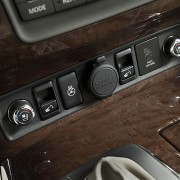
Infiniti QX56 comfort controls2011 Infiniti QX56 - Infiniti Controller
ENGINE: 5.6 liter DOHC 32 Valve V8
HORSEPOWER: 400 hp @ 5,800 rpm
TORQUE: 413 lb-ft @ 4,000 rpm
TRANSMISSION: Electronically controlled 7-speed automatic with Adaptive Shift Control (ASC)
FUEL CONSUMPTION: 14 City MPG/20 Highway MPG
PRICE AS TESTED: $72,475
Source : Carreview.com

2012 Toyota Yaris Spy Photos - Future Cars

While other subcompacts have become seriously stylish, the next-generation Toyota Yaris may settle with “less ugly.”

June 2011
2012 Toyota Yaris Spy Photos
There’s a styling revolution happening in the subcompact-car segment, led by the swoopy Ford Fiesta and championed by the freshly redesigned Hyundai Accent, the snappy Kia Rio, and the funky Chevrolet Sonic. Toyota’s price-leading Yaris undergoes a ground-up redesign for 2012, but, judging by the looks of this prototype—not to mention the Japanese-market Vitz from which it is cloned—Toyota’s entry-level hatch won’t be advancing the state of tiny-car design.
To be fair, the prototype’s bright-white hue washes out certain aspects of the shape. But, as the renderings of the Vitz (that’s the Yaris’s home-market name) shared by Toyota of Japan prove, the car’s design seems somewhat awkward regardless of color. It is rife with random lumps and dips that add character at the expense of cohesion. With its mesh grille and triangular fog-light housings, this particular prototype appears to be, um, the sportiest of all Vitz variants previewed back in March. In other words, this is about as sexy as the 2012 Yaris is going to get. And hey, what’s this? A rear “diffuser”? Toyota’s so funny.
Unfortunately, our spies couldn’t catch any shots of the Yaris’s interior, nor do we know for sure how much power the car will pack under its short hood. But the Vitz info suggests that the American version will adopt the refreshingly normal dash design previewed in the Vitz—albeit with left-hand drive—complete with gauges located in front of the driver where they belong. (The last Yaris’s instrument panel was in the middle of the dash.) We also stand by our prediction that a 1.5-liter four-cylinder engine will be the primary powerplant, aided by either a six-speed manual or a continuously variable transmission and with fuel-economy ratings in the neighborhood of 40 mpg on the highway.
Still hazy is the prospect of a Yaris hybrid, which Toyota showed in concept form at the Geneva auto show in March and pledged to add to its European lineup in the latter part of 2012. A hybrid may be redundant in the U.S., however, since the Yaris shares its basic underpinnings with the even uglier, hybrid-only 2012 Prius C, which became another unwitting target for spy shooters earlier this month. Expect the 2012 Yaris to appear in Toyota showrooms this fall in both five-door hatchback and four-door sedan forms; the future of the bargain-basement three-door model is uncertain. Regardless, pricing for the Yaris should still start below $15K.
Source : Caranddriver.com

Wednesday, June 22, 2011

2011 Subaru Impreza WRX STI tS - First Drive Review

More initials mean less weight and more good for the Impreza WRX STI.

June 2011
2011 Subaru Impreza WRX STI tS
To most people, the Subaru Impreza is a practical compact sedan with enhanced all-weather capability. But enthusiasts have long known its darker side. The WRX alludes to the WRC rally car, and for several years now, Subaru has offered Americans the STI with even more power. Sophistication, however, isn’t the STI’s thing. It is brash and loud, with a wing that makes it look as if it were ready to launch into outer space.
Now, Subaru is trumping its STI with the tS, which stands for “tuned by STI” and strikes us as redundant. The model will only be sold on Subaru’s Japanese home turf, but we were invited to sample one on the back roads and autobahns near the company’s European Test and Development Center in Ingelheim, Germany. With the "tuned by STI" addendum in mind, we fully expected an Impreza with even more outrageous wings and flares. What we were shown instead by the center's general manager, Hideki Arai, was a rather subtle evolution of the STI. We wouldn't exactly call it refined, but even at first glance, it is visibly more mature and sophisticated.
Nine-Pound Fixation
For one thing, the STI tS loses the STI's massive rear wing, instead sporting a discreet lip spoiler. The carbon-fiber roof cuts nine pounds, as does an aluminum hood, and ultra-lightweight wheels with a unique design save another nine apiece. Arai-san points out a strut brace upfront and says the suspension has been reworked extensively. The Impreza STI tS is available only as a four-door sedan.
The powertrain is unchanged from that in the Japanese-market STI: a 2.0-liter turbocharged flat-four making 304 hp and 317 lb-ft of torque. Those who want an automatic can have one, but they get downgraded to a 296-hp 2.5-liter that makes only 258 lb-ft. Called “A-Line,” the automatic car is significantly cheaper than the manual tS.

We went for the six-speed, of course, and it provides a superb driving experience. There is very little turbo lag, and the 2.0 pulls eagerly throughout the power band. Country roads are this car's domain. The tS is compact and agile, and the nicely weighted steering is a joy to bend into corners. The suspension has been retuned and feels slightly softer than in the regular STI, which helps the tS remain composed even on bumpy and uneven surfaces. It also makes the tS a more agreeable companion on the autobahn, where it remains stable and comfortable as it pulls with alacrity up to its 155-mph top speed. Like the regular STI’s, the tS’s exhaust note is remarkably unobtrusive, and for our taste, it could be a bit more aggressive.
BMW in Subaru’s Sights?
But the tS is not about having an aggressive demeanor—it is about sophistication. “We would like to use high tech to compete with the premium segment,” Arai-san explains. And although he acknowledges that Subaru isn't there yet, he would like nothing more than eventually to see the STI tS compared with the likes of a BMW M3. That sounds like a stretch, but we will say that the idea of adding a higher-performing, more tastefully executed level to the WRX family is highly appealing.
Although the tS’s first run of 500 units will be confined to the Japanese market, Subaru is seriously considering launching the line abroad. The tS concept could be stretched to other model lines, perhaps including the imminently arriving two-door sports car. We would like to see the tS further separated from the WRX and STI models, but the STI tS is a great first step. “We will watch the market and would like to get a reaction,” says Arai-san. Ours is emphatically positive.
Source : Caranddriver.com

Tuesday, June 21, 2011

2012 Mini Cooper / Cooper S / John Cooper Works Coupe - Official Photos and Info

More info on the Mini coupe comes out. And this time, the pictures show the full car!

2012 Mini Cooper / Cooper S / John Cooper Works Coupe
Mini’s cars are known for their flingability, but the company is dragging its feet releasing info on its new Cooper Coupe. Last week, we got our first official photos of the car (albeit still partially covered in camouflage) and then got to drive a prototype (again, still partially covered in camouflage). This time, we’ve finally got photos of the whole car—not the concept, not spy shots of a camouflaged production car, not official shots of a camouflaged car, but official shots of a fully exposed production coupe, its thin quarter and rear glass uncovered, its helmet roof and racing stripes revealed in all their glory.

A Quick Re-Cap
There is very little new information accompanying these new photos. For those of you who missed the last few stories, however, here is a recap of this re-capped Cooper: the Mini Coupe is a two-seat, trunk-ated (though not truncated) version of Mini’s feisty hatch, based on the Cooper convertible’s structure. It has the same footprint as the Cooper hatchback, but its roof is roughly an inch lower and it features a faster windshield angle. All three of the 1.6-liter engines offered on other Coopers sold in the States will be available in the coupe: the 121-hp naturally aspirated base four-cylinder, the raucous 181-hp turbocharged version of same, and the wild-child 208-hp John Cooper Works turbo four. Wheels will come in 15-, 16-, and 17-inch sizes, with plenty of different designs available as options.
Thanks to added bracing in the rear bulkhead and elsewhere, the Mini Cooper Coupe will be torsionally stiffer than the hardtop, but, at least in JCW form, it also will be roughly 55 pounds heavier. However, we already know that, thanks to bespoke suspension tuning and brake-based torque vectoring, the coupe is more fun to drive than any other Mini body style. (At least it is for now. Engineers on our drive of the JCW car told us the final calibrations could still change.)
Lots of New Details
So, the news now is that the coupe will be available in nine colors, each featuring a contrasting roof in silver, black, or red. The only exception is black cars, which will be available with a black roof. Racing stripes will be optional. On the hood and trunklid, they will match the roof, and on the roof, they will match the body color. Also, the Coupe’s available xenon headlights may be ordered with a black housing, lending a more sinister appearance to the front end. Park-distance control will be standard, and probably very handy since you may not be able to see much out of the mail-slot rear window.
The Coupe’s cavelike interior comes standard with black upholstery and an anthracite headliner with ovoid recesses maximizing the available headroom. Sport seats are standard across the range, with leather, contrasting piping, and splashes of interior trim color available in option packages. Other options include automatically dimming rearview and exterior mirrors, preparation for a trunk-top luggage rack, the John Cooper Works appearance pack (for non-JCW models), a Harman/Kardon sound system, Bluetooth and USB connectivity, and the Mini Connected system. Inside, the cover separating the passenger compartment from the trunk features integrated headrest fairings that look cool but offer no functional benefit.
We still don’t know exact pricing, curb weight, or when we’ll start this whole sequence of coverage for the Coupe’s topless twin, the Roadster. We will bring those details to you as soon as they emerge. Meanwhile, enjoy these photos of Mini’s racy little two-seater with no camo—finally.
Caranddriver.com

Monday, June 20, 2011

2012 Honda Civic Si Coupe - Road Test

Now Playing: Upsized and downrevved for the enthusiast of tomorrow.

2012 Honda Civic Si Coupe

http://homeautodesign.com/wp-content/uploads/2011/01/2012_honda_civic_si_coupe_concept-4.jpg
For the past six years, we’ve felt a little like Estragon and Vladimir in Waiting for Godot. So many hours have been lost debating whether the previous-gen Honda Civic Si produced enough power to hold its head above water in the pocket-rocket pond. Eventually, this existential controversy morphed into a kind of recreation, with Si devotees screeching fiery epithets from the bleachers. Well, finally, Generation Nine is upon us. “We’re saved!” shouted Beckett’s protagonists whenever they suspected Godot might momentarily appear.
Here’s a sad fact: Godot never showed. And whether the Si is “saved” likewise remains unclear. Let us review recent history.
Our first encounter with the previous Si came late in calendar year 2005, when we pitted it against a Volkswagen GTI. The Honda lost. In 2009, we inserted an Si into a seven-car comparo, where it finished fifth, gasping and sweating. We weren’t surprised. The Si’s engine—2.0 liters, 197 horsepower, 139 pound-feet of torque—relegated it to least-powerful status in the whole segment. It certainly didn’t possess the grits to fend off, say, a 263-hp Mazdaspeed 3 Grand Touring or a 265-hp Subaru Impreza WRX. What’s more, accessing the Si’s horses has always required the spinning of the crank and cams to a fine fare-thee-well. The VTEC didn’t swap cam profiles until 6000 rpm, and it was thereafter vital to rely on every single rev right up to the colossal eight-grand cutoff.
Of course, Si purists—and trust us, they are legion—smugly insisted that the little howler-monkey engine comprised much of the car’s charm. Yet in the same breath, they’d also confess the coppery taste of  humiliation whenever a WRX achieved 60 mph 2.0 seconds in front of them, fast becoming a gnat on the horizon.
Now comes Honda’s solution for the ninth-gen Si, a solution both simple and a little surprising, given the rumors of a turbo. Out goes the 2.0-liter engine, in comes the naturally aspirated 2.4-liter unit that sees simultaneous duty in the Acura TSX. The result is an unnoticeable 4-hp gain, but torque is up 22 percent—peaking at 4400 rpm instead of 6100 rpm—and that’s a difference you can feel. While they were at it, the engineers paired the engine to the TSX’s delightful six-speed transaxle. But is that enough?
original Well, sort of. At the track, the Si nailed 60 mph in 6.3 seconds versus the previous 6.7, and it proved a half-second quicker in our 5-to-60-mph rolling start. Turn off  the traction control, and you can now shred rubber for 15 feet, followed by a Rottweiler bark as you bang into second. An improvement, for sure, but it’s still shy of the accelerative thrust of five turbocharged competitors, including the Speed 3, the WRX, and even the GTI, which has a similarly meager 200 horses but can nonetheless summon 60 mph in 6.1 seconds.
On the other hand, the larger engine ushers in welcome perks. The mechanical thrash of the previous powerplant, for instance, is now largely MIA, and gear noise is likewise reduced, with all three of our sound-level tests confirming the fact. (Still, road-borne noise and tread roar remain issues that Honda must address.) Equally important, the number of shifts required for ’round-town cruising seems subjectively halved. In traffic, the Si is perfectly content relying on first, third, and fifth. And by eschewing a turbo, the Si’s mileage—now up to an observed 26 mpg—is best described as a charming achievement.
Yes, the Si is smokin’ hot. Sixty mph now arrives in 6.3 seconds, 0.4 second quicker than the previous Si. At the drag strip, however, the car will continue to eat the exhaust of its turbocharged competitors.
Yes, yes, 900 top-end revs have been lost. But the car now pulls with at least vague enthusiasm just after step-off. In fact, our only serious beef with the new engine is its considerable overrun when the throttle is suddenly dropped. Among other things, that makes for very little initial engine braking, and the revs sometimes take a couple of seconds to return to idle. Most drivers won’t complain, but it’s a behavior that lends the drivetrain a titch of laziness that has historically been anathema to Honda-think.
As with the previous-gen Si, this is among the most-neutral-handling front-drivers on the planet. Around our 15-mile public-road loop in southern Ohio, we could provoke only the most minor of nibbling understeer—and that was at speeds approaching Fear Factor Nine—with the rear tires faithfully following whatever paths had been established by the fronts. No rotation, no drifts, no drama. Body motions were exquisitely controlled, with the ride revealing the stiff springs and dampers only over high-frequency imperfections, primarily expansion joints and broken pavement.
At around-town speeds, the Si’s steering tends to feel artificial, as if it were the outcome of some sort of electrical/mechanical calculus that never precisely balanced. At least it’s light. As speed rises, fortunately, it firms up nicely and also becomes livelier. There’s no bump steer, no nervousness, and interstate tracking is peerless. The brakes are fade-free, and the pedal is firm and informative.
Moreover, the light, fluid shifter—as good as any that Honda has ever produced—allows the driver to summon alternate rev ranges with the flick of two fingers, abetted by a new lightweight clutch with simply seamless takeup. Faced with slow hairpins, the limited-slip differential carefully apportions power so that the inside front wheel never scrabbles. The thinly cushioned seats hold you firmly in place, and the dead pedal is perfectly sited. With lateral grip rising from 0.87 g to 0.90 g, the Si just dances and sings in the hills. This 2864-pound coupe is perfectly balanced, agile, poised, ever willing, a car that is easy to drive. Real fast comes real quickly.
The only obvious failure here is the unimproved interior. There are crass plastic trim bits on the steering wheel and around the HVAC controls. The Civic’s trademark minivan-sized windshield leans over a mini­van-sized dash, a vast plain of cut-lines, textures, and colors. The bunk-bed layout for the IP is okay, but the garish LCD gauges are right out of a RadioShack in Akron. The mouse-fur headliner suffers from the mange, and there’s a lumpy, wrinkled collar of felt that surrounds the steering column, shouting to one and all, “Yessir, that’s right, I actually am the cheapest bit of flotsam in the universe!” Note to Honda: Check out the Ford Focus’s interior.
The new Si—manual six-speed only—comes in both sedan and coupe forms. The coupe starts at $22,955, the sedan opens at $23,155, and both top out at $24,655. The only options are navigation, XM radio, and (exclusive to the coupe) summer tires—17-inch Michelin Pilot Exalto PE2s, as fitted on our test car. (Fun driving tip: Demand that your spouse call you “Pilot Exalto.”) If you’ve got a calculator handy, you’ll perhaps already know that a starter Si coupe is more than $1500 cheaper than either a GTI or a Speed 3.
This latest Si is more sophisticated than its forebear, although it has been somewhat cruelly left to play David to the turbocharged Goliaths. As of now, it offers a better ride, produces less noise, and is faster in both a straight line and through the most diabolical off-camber, double-apex turns that Ohio’s deranged civil engineers could conjure. It is surely less raw than its predecessor, a trait that many Si purists—including our own revered Tony Quiroga and Dan Pund—lament. Until they commit to a three-day, 800-mile road trip, two-thirds of which skates over frost-heaved interstates. No longer is the Si a one-trick pony. At speed it’s a serial killer, yet during commutes and city errands it’s a near-soothing mental-health counselor with practicality and a price that make it easy to justify.
Source : Carsanddriver.com

Saturday, June 18, 2011

Chevrolet Sonic Price - Cars Reviews

Chevrolet Sonic priced at $14,495


The Sonic will be offered as a four-door sedan and a five-door hatchback. It replaces the Chevy Aveo, which was priced $2,249 below the new Sonic's sticker
USA AUTO - Prices for the Chevrolet Sonic small car will start at $14,495, including shipping, when sales begin this fall, General Motors said today.
That puts the Sonic $500 above the base-model Ford Fiesta, a key competitor in the subcompact segment. But the Sonic will be priced below the Honda Fit, which stickers at $15,870, including shipping.
The Sonic will be offered as a four-door sedan and a five-door hatchback. It replaces the Chevy Aveo, which was priced $2,249 below the new Sonic's sticker.
GM says the Sonic will come with the most standard safety equipment among subcompacts, including electronic stability control and 10 airbags. Keyless entry and 15-inch alloy wheels also are standard.
"Today's customers have high expectations for small cars," Rick Scheidt, vice president of Chevrolet marketing, said in a statement. "Sonic comes with an unexpected level of standard equipment so that every customer will have comforts and amenities they desire."
http://www.carshowp.com/wp-content/uploads/2011/01/2012-chevrolet-sonic-sedan-interior-view.jpg
The car, which comes with a base 1.8-liter Ecotec engine mated to a five-speed manual transmission, will come in three models. The lineup, with prices that include shipping, includes:
* LS: Sedan starts at $14,495; hatchback at $15,395. In addition to the safety features, the package includes traction control and antilock brakes.
* LT: Sedan starts at $15,695; hatchback at $16,495. The package adds a six-speaker premium sound system, heated front seats and side mirrors, 17-inch alloy wheels and cruise control.
* LTZ: Sedan starts at $17,295; hatchback at $17,995. It gets all the features on the LT plus a connectivity package that includes a USB port, Bluetooth and steering-wheel-mounted audio controls.
Buyers can upgrade to a six-speed automatic transmission for $1,070. The LT and LTZ models offer and optional 1.4-liter turbo with a six-speed transmission for an additional $700.
GM will build the Sonic at its Orion assembly plant in suburban Detroit. It will be the only U.S.-made subcompact, the result of a 2009 agreement with the UAW that will allow GM to hold down costs by paying an entry-level wage to 40 percent of workers at the plant.

Friday, June 17, 2011

2012 Mini John Cooper Works Coupe - Prototype Drive

It’s more fun, but Mini won’t tell us exactly why.
2012 Mini John Cooper Works Coupe
Specifications
“With a car like this,” Rauno Aaltonen says, “sportier is a bad word, because the extreme, if you take it too far, would be wipers on the side screens.”
Aaltonen knows from side-screen wipers. Here we have one of the world’s great rally drivers—an original Flying Finn, a spry 73-year-old former champion who has spent much of his working life on dirt. He is standing at a paved track in Austria, referring to the prototype Mini John Cooper Works coupe we’re here to drive. He is cautioning us against wanting too much.
Good advice, but with the coupe’s looks, much is promised. The Mini JCW coupe—and that’s what we’ll call it, because “Mini John Cooper Works coupe” just sounds all Anglophile Rain Manis a two-seat, fixed-roof version of the Mini Cooper hatchback. It shares a platform with the current Mini convertible and upcoming Mini roadster, and it’s intended to round out the brand’s lineup in a flashy, attention-getting fashion. It is not—not, insist Mini marketing people—supposed to be the fastest or the most hard-core dog in the litter. Which is kind of confusing, given that it looks the part.
The premise is simple. British tuners like Broadspeed and Unipower built two-place, Mini-based funsters in the 1960s, so the coupe has historical precedent. To keep costs down, the convertible’s unibody was essentially ported over. The coupe gains steel reinforcements in the sills and trunk but is otherwise a convertible from the beltline down. The windshield angle drops by 13 degrees, and a helmet-like steel roof has been welded over the cockpit, complete with a long trunklid and two spoilers. The rearmost spoiler is active, rising automatically at 50 mph and producing a claimed 88 pounds of downforce.
The rest is details. Driveline choices are unchanged from the rest of the Mini lineup, which is to say, everything from ordinary (122-hp Cooper) to feisty (208-hp John Cooper Works). Europe gets a 143-hp diesel four that Americans will never, ever see. All coupes come standard with a six-speed manual. Cooper and Cooper S buyers can opt for a six-speed automatic. The suspension geometry, the wheelbase, the wheel choices—almost everything else is standard-issue Mini.

Given the ordinary Mini’s chassis talent, that isn’t necessarily a bad thing. The big surprise is weight. The coupe is about 55 pounds porkier than a standard Mini hatch, thanks partly to the chassis reinforcements and active spoiler. (The latter alone adds 12 pounds.) This is a trivial bump, but if you’re giving up a rear seat, you should gain lightness, not lose it. Thanks to the new windshield, height falls by about an inch, to 54.5 inches. A whopping 10 cubic feet of cargo can fit underneath the trunklid, more if you take advantage of the standard pass-through between the two seats.
From the cockpit, the coupe doesn’t seem that different. The low roofline is annoying only when you look out the side windows and feel like Dumb Donald from the Fat Albert series, eyes up under your hat. The standard, cave-like black headliner and the dinky glass area keep the rearview mirror from telling you much. All the familiar brand cues are present, including the dash-mounted toggle switches and that ridiculous pizza-sized central speedometer.
Surprisingly, the coupe’s charms lie at speed. Our Austrian seat time was limited to John Cooper Works models, only on a smooth track, and only in the dry. In that idyllic environment, everything worked. The John Cooper Works four is a torquey symphony of farts, fizzes, and pops, a candy-coated gem of an engine. The cockpit isn’t too noisy, and wind noise isn’t excessive. With stability control on, this coupe reminds you of other Minis—talkative steering, taut body motions, progressive brake and clutch feel.
Turn off the stability control, however, and all hell breaks loose. Freed from the bonds of computer-managed balance, the JCW giddily backs itself into corners, chucking its ass out at the slightest rough turn-in or throttle lift. Inside wheelspin is everywhere, understeer only present if you abuse the gas with too much steering cranked in. It’s wonderful. This is what you thought front-drive cars were like when you were five years old: small, manic, and desperately in need of, to quote Aaltonen, side-screen wipers. And it’s one step crazier than the rest of the Mini lineup.
Wait, what?
When pressed, Mini staff admit that the coupe’s suspension tuning might differ from that of the hatch. They are not overly forthcoming on this point, only hinting that the damping is a bit stiffer and that the base Cooper coupe wears the 18-mm rear anti-roll bar from a Cooper S hatchback. “With the coupe,” says Mini engineer Heinz Krusche, “we tried to overcome the additional weight, to make the car as agile as the hatch. But at the moment”—he hesitates, as if unsure whether or not to continue—“it looks like we are perhaps a little bit more agile.”
We asked if the car would be detuned for production, maybe for the sake of ride quality and to match the tamer handling of its brethren. No answer. It’s all wonderfully suspicious, as if the boys in engineering were trying to pull a fast one on the rest of the company. If so, bully for them. A car that looks like this should drive this nutty.
About that: Buy a Mini coupe, people are going to gawp. The styling is divisive—this is an in-your-face, impractical version of an otherwise sensible machine, and it’s rife with contradiction. It’s targeted at masculine buyers but looks about as butch as a pink summer hat. It may or may not end up feeling sportier than its siblings. And although it’d be nice if the prototype’s giddy handling sees the showroom, that might not be appreciated by those who buy the car for its looks.
Our hosts in Austria didn’t seem bothered by this, but perhaps that’s intentional. As on most prototype drives, we weren’t given a lot of straight answers. Except from Aaltonen. He likes it sideways. Go figure.
Update: This version of the story corrects a typographical error in estimated curb weight and revises our estimated base price downward by $1000.
Source : Caranddriver.com

Twitter Delicious Facebook Digg Stumbleupon Favorites More

 
Design by Free WordPress Themes | Bloggerized by Lasantha - Premium Blogger Themes | Affiliate Network Reviews